
Calhoun County Deed Records Access and Search
Calhoun County deed records are filed with the Clerk of Court in St. Matthews, South Carolina. The county sits in the central part of the state, bordered by Richland, Lexington, and Orangeburg counties. Calhoun is one of South Carolina's smaller counties by population and area, with a largely rural character. The Clerk of Court serves as the recording authority and maintains all land instruments filed in the county. Records are public and can be accessed online through statewide tools or in person at the courthouse.
Calhoun County Quick Facts
Calhoun County Clerk of Court and Recording Services
The Clerk of Court in Calhoun County performs the recording function for all real property instruments in the county. There is no separate Register of Deeds office. The Clerk receives documents for filing, assigns instrument numbers, maintains the grantor-grantee index, and provides public access to all recorded instruments. The office is located in the Calhoun County Courthouse in St. Matthews and serves the entire county.
The SCIWAY county recording directory at sciway.net includes Calhoun County in its statewide list of recording offices, making it easy to find contact details and compare how recording is handled in different South Carolina counties. For the most current office hours and fees, contacting the Clerk of Court directly is recommended.
| Office | Calhoun County Clerk of Court |
|---|---|
| Address | 302 South Railroad Avenue, St. Matthews, SC 29135 |
| Phone | (803) 874-3524 |
| Hours | Monday - Friday, 9:00 AM - 5:00 PM |
| Website | sciway.net/gov |
Online Access to Calhoun County Deed Records
Searching Calhoun County deed records online is possible through two main tools. The SC Land Records portal is a free statewide platform that includes documents from participating counties. It allows searches by name, document type, and book and page reference. For Calhoun County, the portal may cover recent filings more fully than older historical records, which may require a direct request from the Clerk of Court.
The SC Property Checker for Calhoun County provides another route to deed and ownership data. This tool aggregates property records into a searchable database and displays ownership history, transfer dates, and parcel information. For researchers who need a quick ownership check, this is often the fastest approach before pursuing full document images.
The image below is from the SC Property Checker for Calhoun County, showing deed record information and property ownership data for parcels in the county.
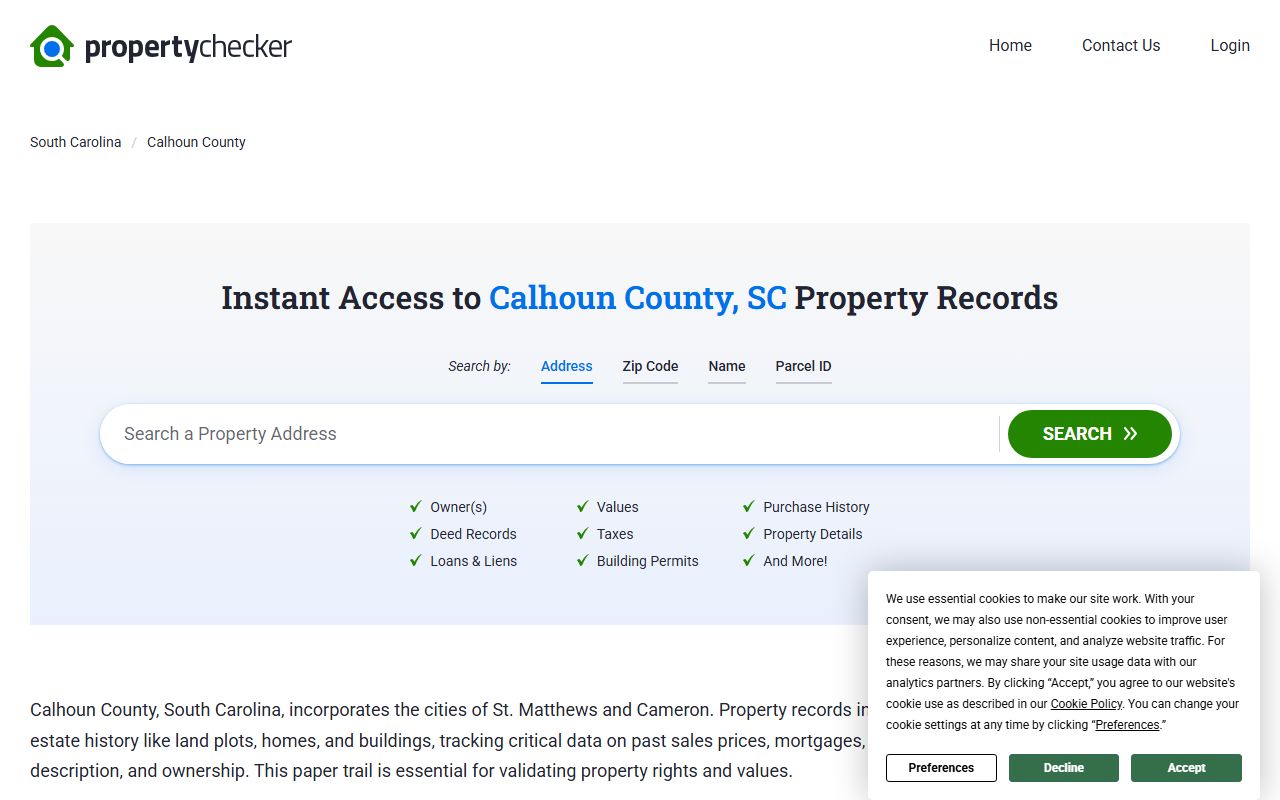
The tool gives a useful overview of ownership and deed history for Calhoun County properties before committing to a full courthouse research trip.
The SCIWAY directory page shown below lists Calhoun County recording office information and links to deed record resources for all 46 South Carolina counties.
The SCIWAY directory is a reliable reference for locating recording offices and understanding how each county manages its land record system.
Note: For Calhoun County records older than what is available online, a direct request to the Clerk of Court or a visit to the South Carolina Department of Archives and History may be necessary.What Calhoun County Deed Records Show
A recorded deed in Calhoun County includes the standard elements required under South Carolina law. The grantor and grantee are named with their addresses. A legal description of the property, in metes and bounds or by plat reference, defines the boundaries of the land being conveyed. The consideration, whether a dollar amount or a stated reason such as "love and affection," appears on the face of the deed.
The recording date and instrument number are assigned by the Clerk at the time of filing. Deeds executed after July 1, 1976 must include a derivation clause under Section 30-5-35 of the South Carolina Code. This clause names the prior deed or instrument through which the grantor received title, giving searchers a direct link to the previous entry in the chain of ownership. The grantee's mailing address is also required on these documents.
Additional elements that may appear on a deed include easements, deed restrictions, plat references, and homeowners association covenants. These encumbrances are part of the public record once the deed is filed. Tax map numbers tie the deed to assessor records for parcel identification.
Instruments Recorded in Calhoun County
The Calhoun County Clerk of Court records all standard real property instruments. Warranty deeds are the most common type and come with the grantor's guarantee of clear title. Quitclaim deeds transfer only the interest the grantor holds, with no warranty attached. Deeds of gift convey property without a sale price, which is typical in family transfers. All three types are recorded in the same index.
Mortgages and deeds of trust are filed when a lender secures an interest in real property. Plats are recorded when a property is formally surveyed or a subdivision is created. Mechanics liens protect contractors and subcontractors who have not been paid for work on a property. Tax liens are filed when property taxes go unpaid. UCC financing statements are recorded for personal property security interests. Powers of attorney related to real property transactions round out the types of instruments filed with the Calhoun County Clerk.
South Carolina Recording Law and Calhoun County Deeds
All deeds filed in Calhoun County must comply with Title 30, Chapter 5 of the South Carolina Code. Section 30-5-30 requires every deed to be acknowledged by the grantor before a notary public or proved by a witness before the Clerk will accept it for recording. This step verifies that the grantor signed the document intentionally and with knowledge of its contents. Without a proper acknowledgment, the document cannot be recorded.
The deed transfer fee under Section 12-24-10 is $1.85 per $500 of the property's stated value. This fee falls on the grantor. A base per-page recording fee also applies, typically $10 to $15 for the first page and $5 for each additional page. Once lodged with the Clerk, the document must be recorded within 30 days under Section 30-5-90. Timely recording establishes priority over subsequent instruments and provides constructive notice to future buyers and lenders.
Lien recording in Calhoun County follows the rules of Section 30-7-70, which sets the standards for filing and determines the order of priority among competing creditors.
Certified Copies and Public Access
Certified copies of Calhoun County deed records are available from the Clerk of Court. These copies carry the official seal and are suitable for legal use. Standard uncertified copies are also available for research at a lower cost. Requests can be made in person or by mail. Providing the book and page number or the instrument number will speed up any document request.
All deed records in Calhoun County are public under S.C. Code Section 30-4-10, the South Carolina Freedom of Information Act. Any person may view or copy any recorded instrument without providing a reason. Privacy rules allow individuals to request that Social Security numbers be removed from online versions of filed documents. The physical record is not changed by such a request.
Historical Records and Genealogy Research in Calhoun County
Calhoun County was formed in 1908 from parts of Lexington and Orangeburg counties, so its own deed record history begins in the early twentieth century. Researchers tracing earlier land ownership in the area will need to look at records from both Lexington County and Orangeburg County for periods before 1908. The South Carolina Department of Archives and History holds records from across the state, including those that predate county formation, and is a key resource for historical land research.
The OnGenealogy SC land records directory lists available online resources by county. For Calhoun County and its predecessor jurisdictions, the directory can help identify what has been digitized or microfilmed for genealogical access. FamilySearch also indexes some South Carolina land records, though coverage varies by county and time period.
Related Property Data for Calhoun County
Deed records alone do not tell the full story of a Calhoun County property. The county assessor maintains parcel records and tax values for every property in the county. These records, linked to deeds by tax map number, show current ownership and assessed value. GIS mapping tools provide a visual overlay of parcel boundaries on a geographic map, helping confirm that a deed's legal description corresponds to the correct physical location.
Probate records from the Calhoun County Probate Court can round out a title search when property has passed through an estate. Any real property transferred by probate order is eventually recorded in a deed with the Clerk of Court, creating a link in the chain of title that a full title search should capture.
Nearby Counties
Calhoun County sits in the center of South Carolina and is bordered by several counties, each with their own deed record offices.