
South Carolina Deed Records
South Carolina deed records are public documents that show ownership, transfers, and the legal history of real property across the state. Each of the 46 counties maintains its own recording office. These offices hold deeds, mortgages, plats, liens, and other documents that affect title to real estate. State law under Title 30 of the South Carolina Code of Laws sets out the rules for how deed records must be prepared, acknowledged, and filed. This guide explains how the system works, where records are kept, what they contain, and how you can find them.
South Carolina Deed Records Quick Facts
Where Deed Records Are Kept in South Carolina
South Carolina deed records are maintained at the county level. There is no single state repository that holds all recorded deeds. Instead, each county has its own recording office that accepts, processes, and stores these documents. Understanding which office handles recording in a given county is the first step in finding a deed record.
The state uses three different structures for county recording offices. Six counties have an elected Register of Deeds: Aiken, Berkeley, Charleston, Dorchester, Greenville, and Lexington. Seventeen counties have an appointed Register of Deeds. These include Anderson, Beaufort, Cherokee, Chesterfield, Clarendon, Colleton, Georgetown, Horry, Jasper, Kershaw, Lancaster, Oconee, Orangeburg, Pickens, Richland, Spartanburg, and Sumter. In the remaining 23 counties, the Clerk of Court handles deed recording along with other court duties. On January 1, 1998, South Carolina renamed the recording position from Register of Mesne Conveyances (RMC) to Register of Deeds (RoD). Some counties kept the older RMC name for the duration of the current officeholder's term, so you may still see it used in certain places.
At the state level, the SC Land Records portal at sclandrecords.com provides a centralized search tool covering all 46 recorder districts. Users can search by party name and view short legal property descriptions. Documents are assigned sequential reel and page numbers and scanned into the system. Images are available at public access terminals in each county office and through the online portal. Microfilm copies serve as permanent historical records. In most cases, original documents are returned to the land owner after recording is complete.
The SC Judicial Branch maintains a directory of all Register of Deeds offices statewide. It includes contact information, office hours, and links to county-level search tools for South Carolina deed records.
The SC Judicial Branch Register of Deeds directory lists contact details and search resources for every county recording office that handles South Carolina deed records.
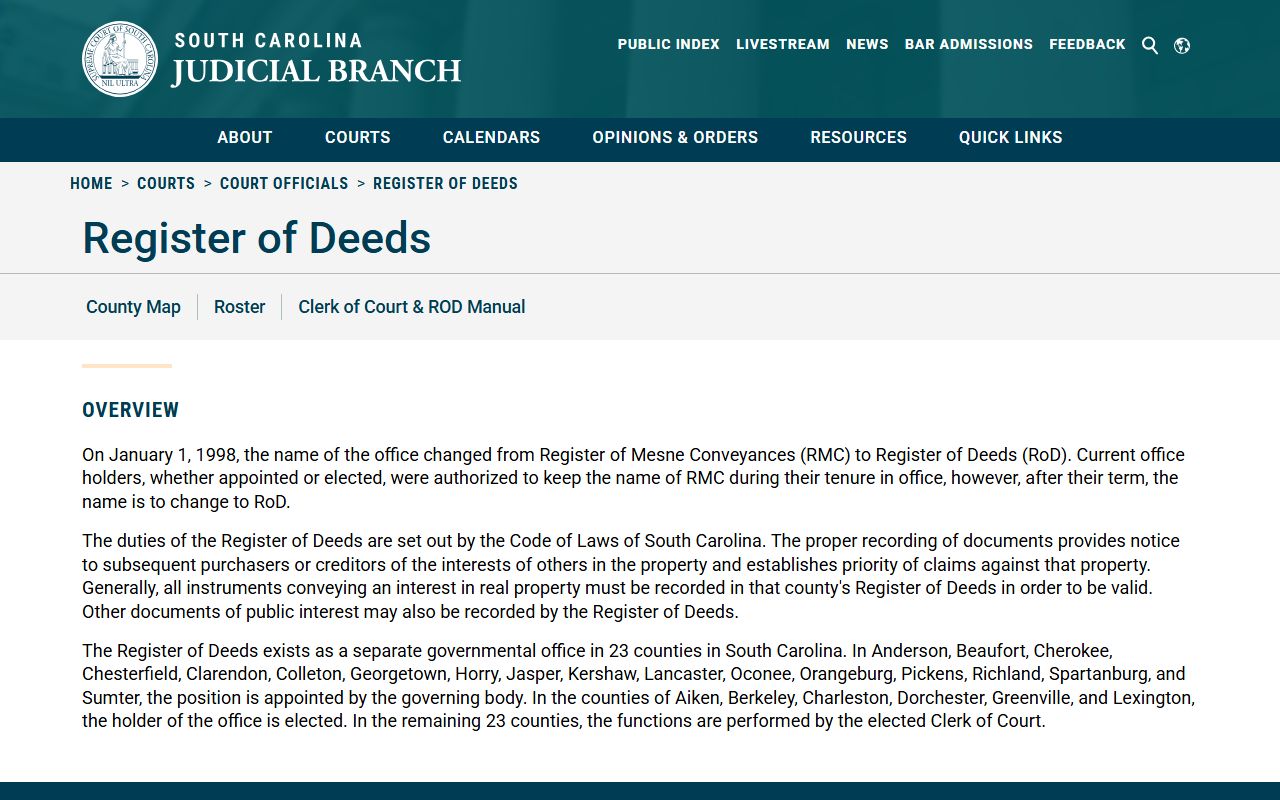
This directory is the most direct way to locate the right recording office when you need to search or file South Carolina deed records in a specific county.
Note: Some smaller counties have limited online access tools, so contacting the office by phone is often the fastest way to confirm what is available for older South Carolina deed records.
How to Search South Carolina Deed Records
There are two main ways to search South Carolina deed records. You can search online through the statewide portal or individual county tools, or you can visit a recording office in person. Both methods give access to the same underlying records, though online tools may not cover the oldest historical documents in the system.
The statewide portal at sclandrecords.com is the most practical starting point for most searches. It indexes South Carolina deed records by grantor and grantee names and includes a short legal description of the property covered by each transaction. Basic searches are free. Some counties offer subscription-based access with additional features. Richland County, for example, offers daily, weekly, monthly, and annual subscriptions for expanded online access. Most counties also maintain their own separate portals that may include more detail or more current updates than the statewide system alone provides.
For in-person searches, you visit the county Register of Deeds or Clerk of Court office where the property is located. Staff can direct you to index books, computer terminals, or microfilm readers depending on the age of the record. Most offices provide public access terminals at no charge. Copies typically carry a fee per page. Bring the property address, parcel number, or owner name to speed up the process.
The SCIWAY directory of South Carolina county Register of Deeds offices provides a quick reference for finding contact information for all 46 counties in one place.
SCIWAY maintains a full directory of all 46 county Register of Deeds offices with contact information and links to local South Carolina deed records resources.
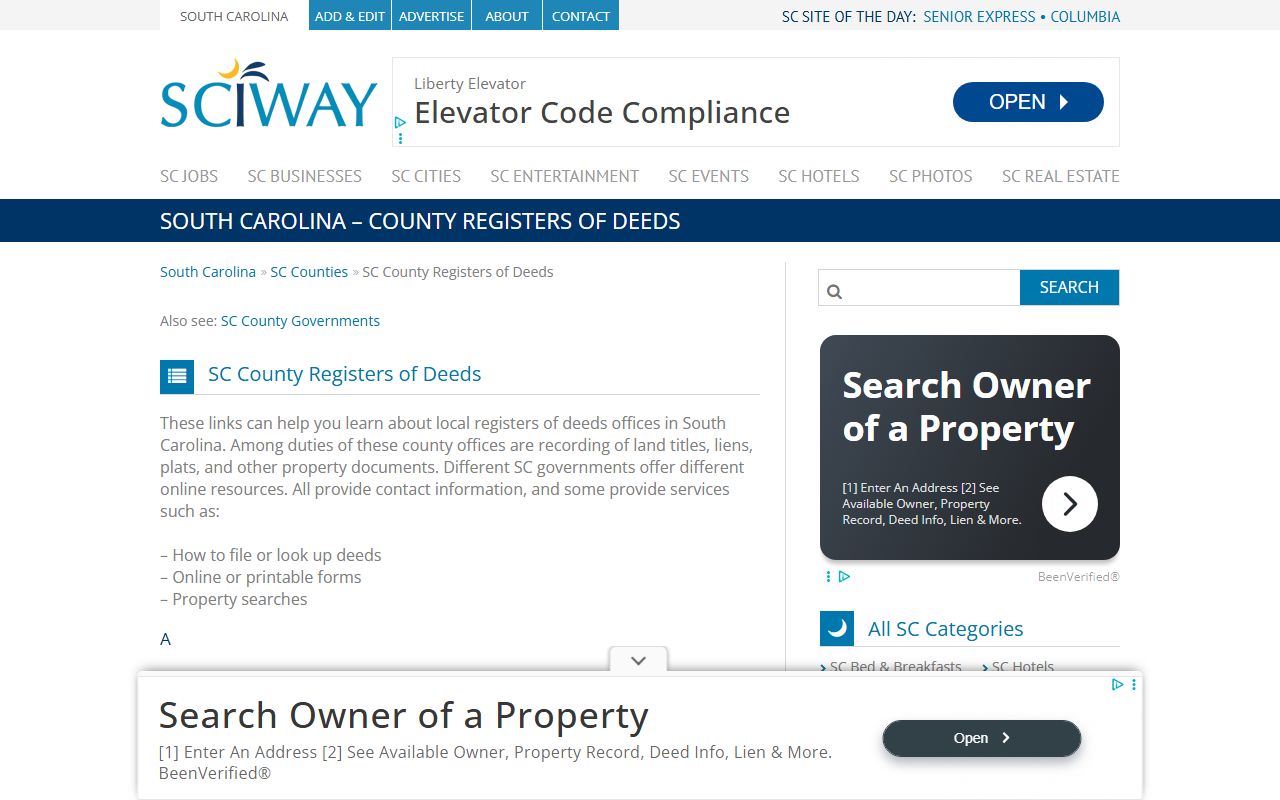
This directory is especially useful when you need to find a phone number or address for a specific county office before making an in-person visit.
The SC Land Records Real Property Official Records Search portal lets you search by name across all 46 South Carolina counties. It is the primary statewide tool for looking up deed records online.
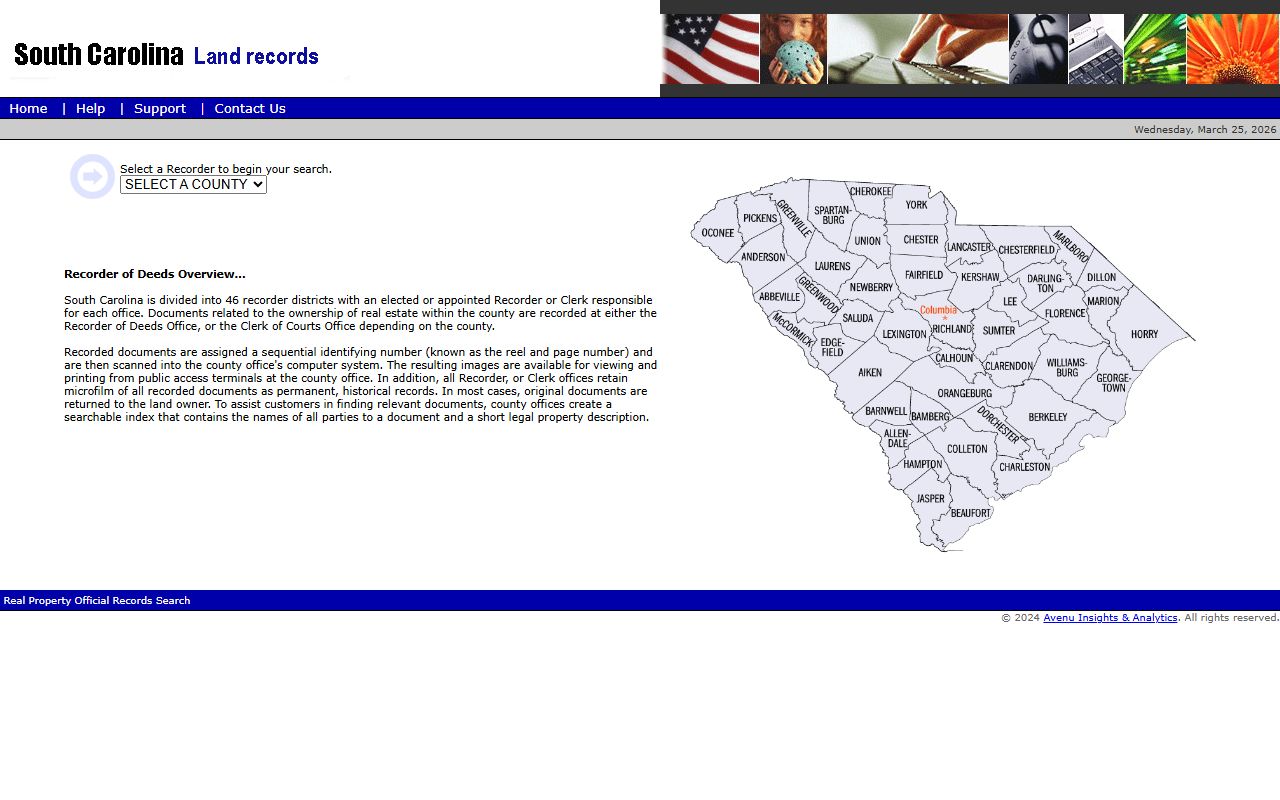
Search results display document type, recording date, grantor and grantee names, and the reel and page number assigned at recording. This gives you enough detail to locate and retrieve the full South Carolina deed record you need.
What South Carolina Deed Records Contain
South Carolina deed records hold a wide range of information about real property and its history. A standard warranty deed includes the names of the grantor (seller) and grantee (buyer), the date of the transaction, the consideration amount paid, and a full legal description of the property. The legal description goes beyond a street address. It includes the lot number, subdivision name if applicable, and a survey-based description that identifies the exact boundaries of the parcel on the ground.
Beyond basic ownership transfers, deed records may also contain restrictions placed on property use, easements granted to neighboring owners or utility companies, and references to prior deeds that establish the chain of title. Mortgages and deeds of trust show financing arrangements tied to the property. Plats provide graphic representations of lot boundaries and are recorded separately but indexed alongside deed records. Mechanics liens and tax liens appear in the records when contractors or government agencies assert claims. Powers of attorney related to real estate transactions are also recorded in the same system, as are death certificates when they are relevant to a title transfer.
Financing statements (UCCs) for personal property, notices of partnership formation or dissolution, and bonds for public officials are also recorded through county offices. Each document is assigned a unique reel and page reference at the time of recording. This reference makes retrieval straightforward once you have it. The AFX guide to South Carolina property search walks through the key sources and methods for finding ownership and deed history in the state.
This resource is a helpful starting point for anyone new to searching South Carolina deed records who wants a clear explanation of how the system is organized and what to expect.
Note: Deed records reflect legal ownership as shown in recorded documents, but they do not guarantee that a property is free of all claims or defects in title.
South Carolina Deed Recording Requirements
South Carolina law sets specific rules for how deeds must be prepared and submitted for recording. These rules are found in Title 30, Chapter 5 of the South Carolina Code of Laws. Following these requirements is necessary for a deed to be accepted by the recording office and to have full legal effect against third parties who may later claim an interest in the same property.
Section 30-5-30 requires that before a deed can be recorded, it must be acknowledged by the grantor or proved by the affidavit of a subscribing witness. This acknowledgment must be taken before an officer in South Carolina who is competent to administer an oath. Notaries public, magistrates, and other state-authorized officials can serve in this role. The acknowledgment confirms that the person who signed the deed did so willingly and with full knowledge of its contents. Without proper acknowledgment, the county recording office will reject the document.
Section 30-5-35 adds requirements specific to deeds executed after July 1, 1976. These deeds must include a derivation clause stating how the grantor acquired the property, and must also include the mailing address of the grantee. The derivation clause helps establish a clear chain of title and makes it easier for future searchers to trace ownership through prior South Carolina deed records. Section 30-5-90 requires that every recorded writing be indexed within thirty days after it is lodged for recording. This rule keeps the public index current and ensures newly filed documents become searchable without undue delay.
The SC Code of Laws recording requirements under Title 30 set out the full legal framework governing how South Carolina deed records must be prepared before they can be accepted for filing at a county office.
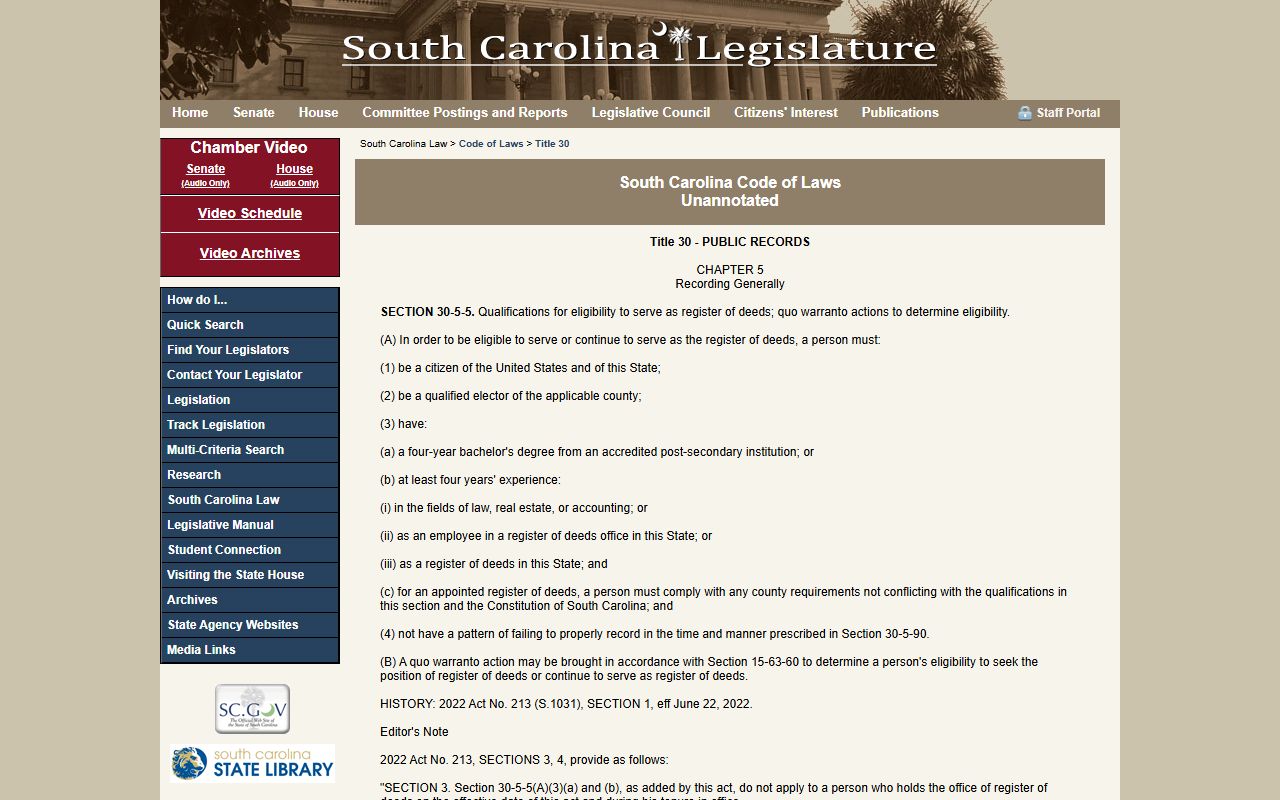
Reviewing the statute before preparing a deed ensures that your document will be accepted on the first submission and will not need to be corrected or re-executed before it can be recorded.
Note: Deeds that fail to meet statutory requirements may be rejected by the recording office or may not give the full legal protection against later claims that a properly recorded South Carolina deed provides.
Deed Recording Fees in South Carolina
South Carolina imposes a deed recording fee under Title 12, Chapter 24 of the Code of Laws. This fee applies to the privilege of recording a deed that conveys an interest in real property. The rate is $1.85 for each $500 or fractional part of $500 of the realty's value. The calculation uses the fair market value of the consideration paid, not the assessed value or any other figure. The fee is the legal responsibility of the grantor, meaning the seller or person conveying the property must pay it at the time of recording.
As an example, if a property sells for $250,000, the calculation covers 500 units of $500, producing a fee of $925. If the sale price falls on an exact multiple of $500 there is no fractional unit added. If it falls between multiples, the next full unit is counted. The South Carolina Department of Revenue Deed Recording Fee Manual provides detailed guidance on how to calculate the fee for different transaction types, including gifts and transfers where no cash changes hands. This manual is updated periodically and is the authoritative source for current fee calculation rules.
The Cornell Law resource covering South Carolina deed fee regulations provides additional detail on how state rules govern the calculation and payment of recording fees for deed records.
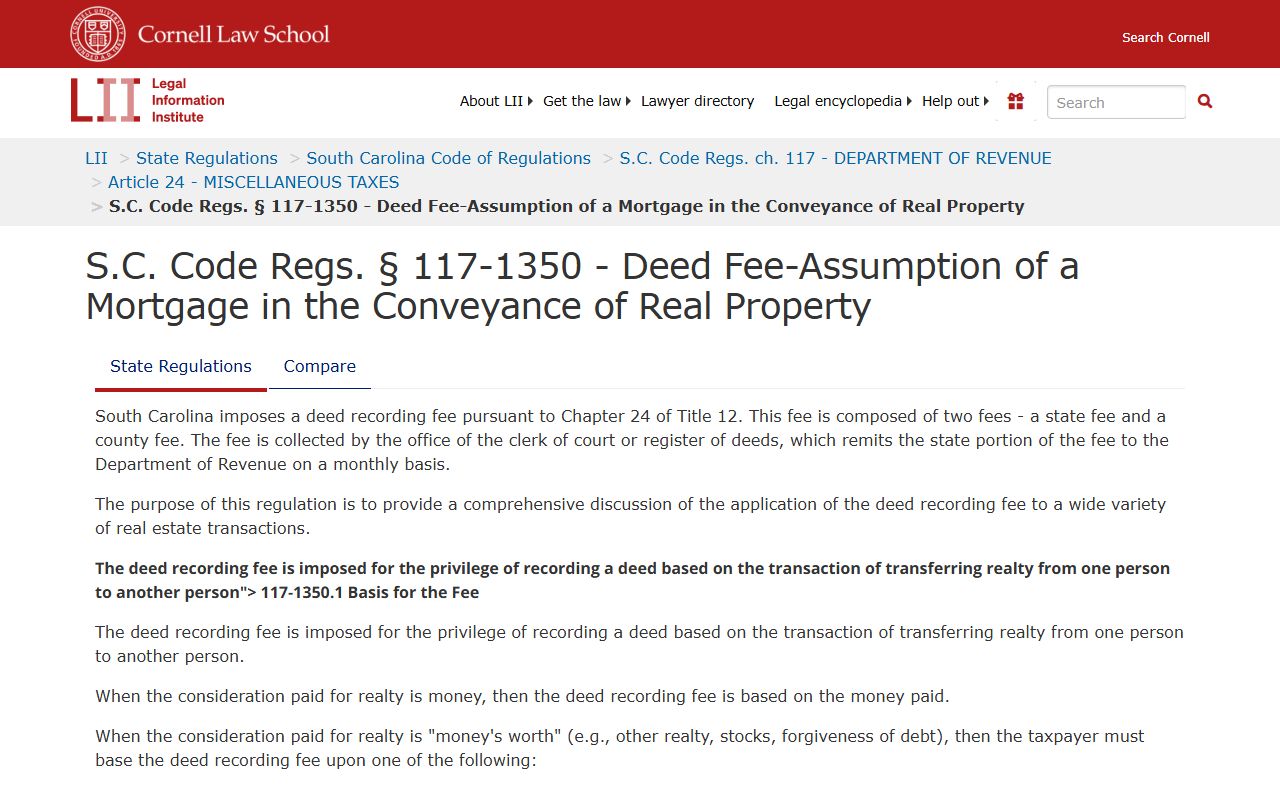
Understanding the fee structure before a closing helps all parties plan for recording costs as part of the overall transaction budget, so there are no surprises at the time of filing.
Beyond the deed recording fee, individual county offices may charge additional fees for copies, certifications, or expedited processing. These fees vary by county and are set at the local level. Confirming the current fee schedule with the specific county recording office before submitting documents avoids delays.
Historical Deed Records in South Carolina
South Carolina holds some of the oldest deed records in the United States. The state's long history as a colonial settlement means that property records in some counties date back more than 300 years. These historical records are valuable for genealogical research, title searches, and understanding early land use patterns across the region.
The South Carolina Department of Archives and History (SCDAH) maintains historic land records, state land grants, and property documents covering the colonial period through the present. The SCDAH holds original records and digital copies of many early documents, including plats for state land grants that predate the county recording system. Researchers can access these records online or in person at the Archives facility in Columbia. The collection is especially rich for the 18th and 19th centuries. It supports both genealogical research and legal title work involving South Carolina deed records that span multiple generations of ownership.
The South Carolina Department of Archives and History online research portal provides access to historic land records and property documents for South Carolina deed records research going back to the colonial era.
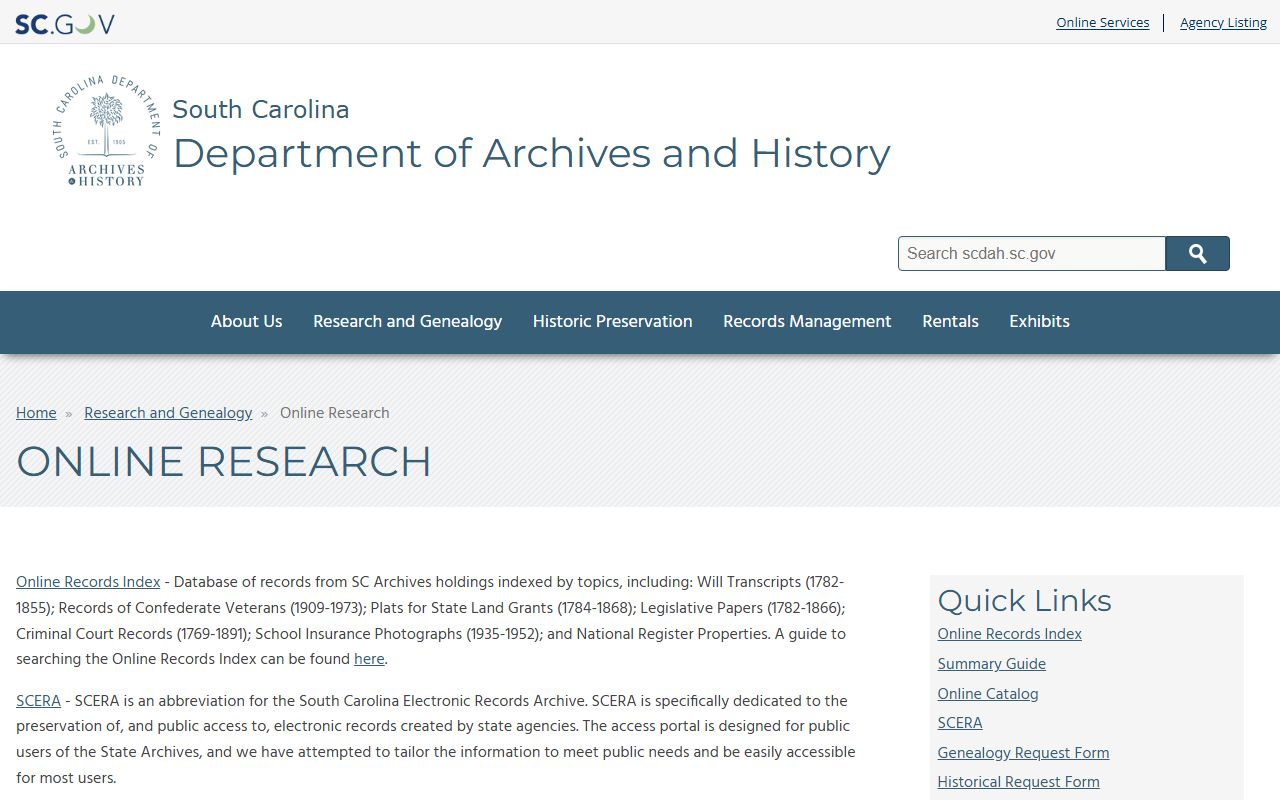
The SCDAH portal is an essential starting point for anyone researching property or family history in South Carolina prior to the 20th century, particularly for records that predate county-level recording.
Charleston County holds the oldest deed records in the state. Documents there date to 1719. Greenville County records begin in 1786, and Anderson County conveyance books go back to 1789. The Charleston County historical deed books collection represents one of the richest county-level archives in the southeastern United States. These books document land transactions from the early colonial period and include records tied to some of the state's most significant early landowners and estates.
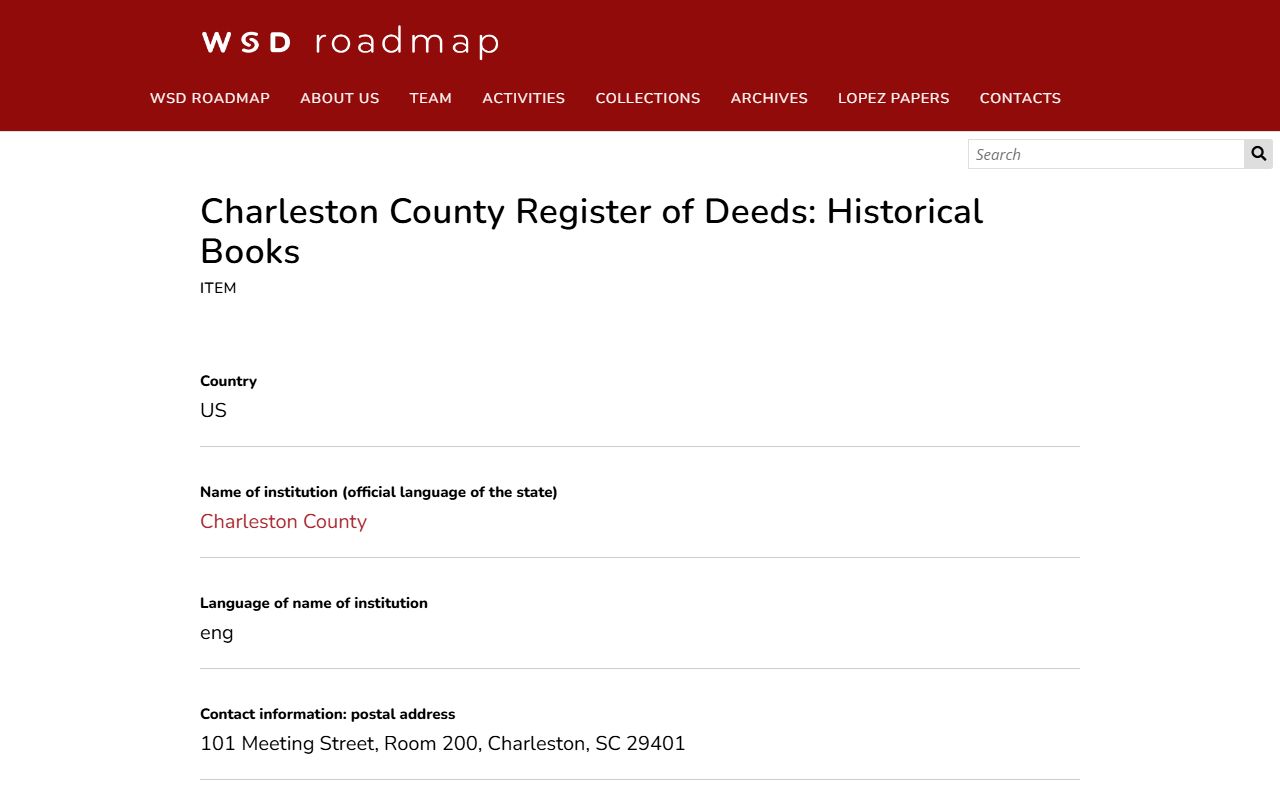
The depth and age of Charleston County's deed records reflects its role as the center of early colonial commerce and government in South Carolina.
For research spanning multiple counties, the OnGenealogy South Carolina land records directory compiles links to online resources county by county. This makes it easier to locate records that cross county lines or predate modern recording systems currently in use.
Note: Some pre-1900 deed records exist only on microfilm or in original paper form and are not searchable online, requiring an in-person visit or a written request to the county recording office or state archives.
UCC Filings and Liens in South Carolina Deed Records
Not all documents recorded with South Carolina Register of Deeds offices relate to real property transfers. The recording system also captures liens and financing documents that affect the legal status of both real and personal property. Understanding these records is important for anyone doing a thorough title search or reviewing the full legal history of a property in South Carolina.
Uniform Commercial Code (UCC) financing statements are used to secure interests in personal property. In South Carolina, the Secretary of State's Office maintains the central UCC filing system. For personal property that is attached to real estate, known as fixtures, a UCC fixture filing must be submitted to both the Secretary of State and to the county Register of Deeds where the real estate is located. This dual-filing requirement ensures that anyone searching either system will find the lien. The Secretary of State's UCC division can be reached at 803-734-2171 for questions about filing requirements or existing records.
The SC Secretary of State UCC filing information page explains how UCC records work in South Carolina and clarifies the rules for fixture filings that must also be recorded with county deed offices.
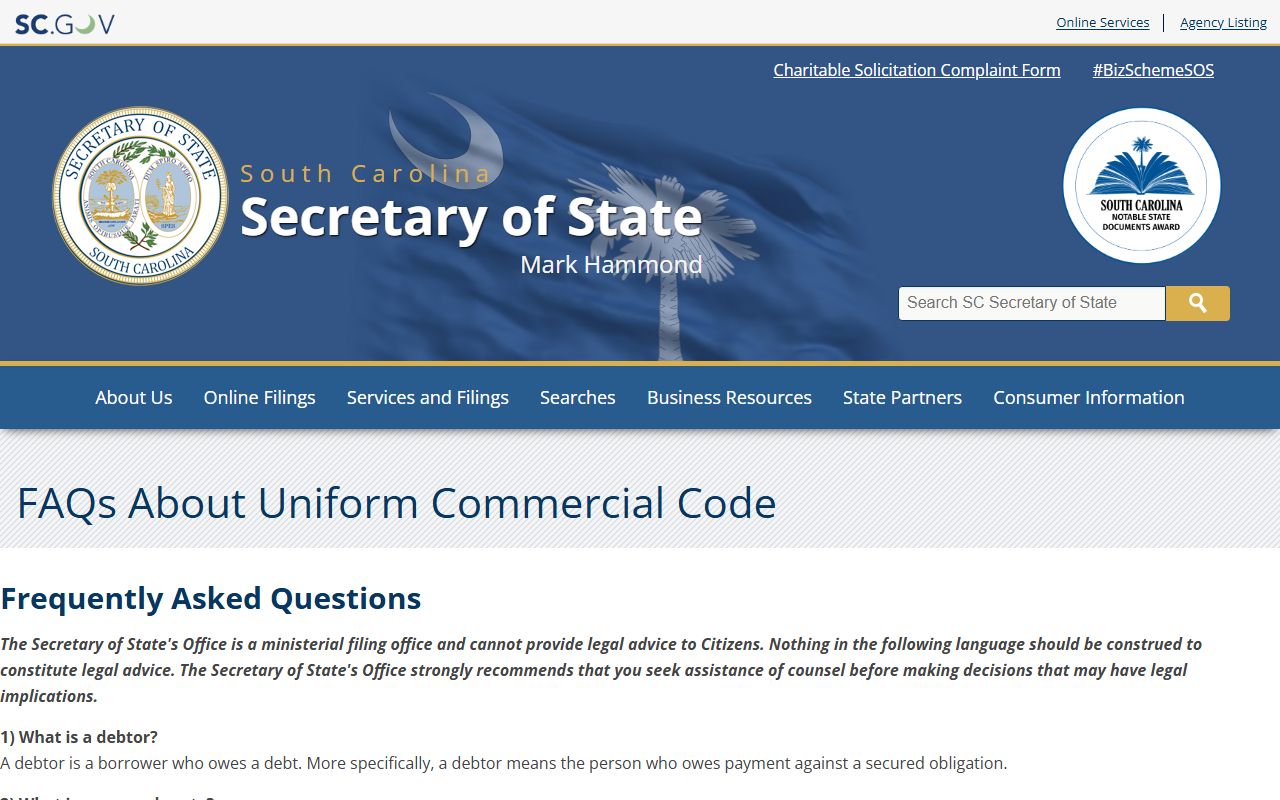
Reviewing UCC filings is a critical step in any thorough property due diligence process, especially for commercial real estate where equipment and fixtures may carry separate financing arrangements.
Under Section 30-7-70 of the South Carolina Code, liens on personal property that are required to be recorded with the Register of Deeds must be witnessed and acknowledged in the same manner as deeds. These documents are recorded and indexed in a separate book titled "Miscellaneous Liens on Personal Property." This indexing system keeps personal property liens organized and searchable alongside real property deed records in South Carolina.
SC Code Section 30-7-70 sets out the legal requirements for how personal property liens must be executed and filed with county recording offices that handle South Carolina deed records.
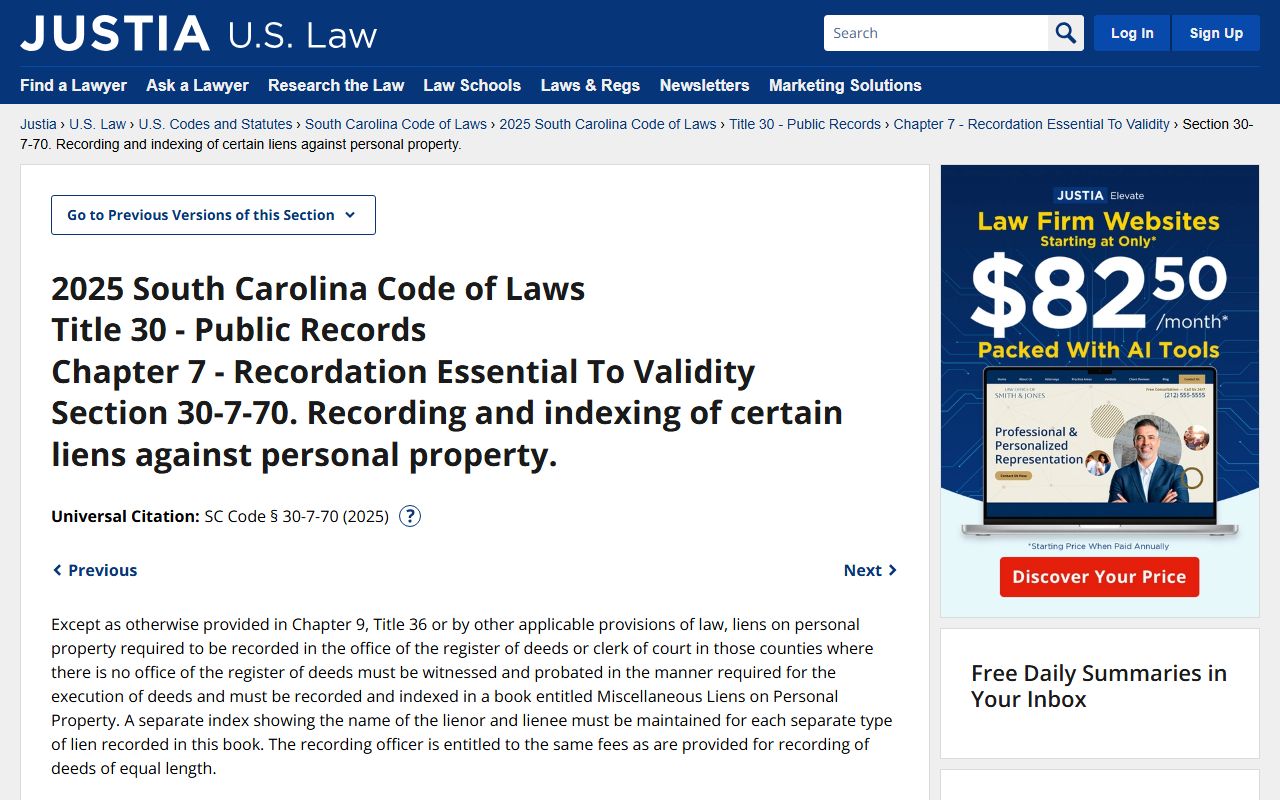
This statute ensures that personal property liens receive the same level of public notice as real property documents, giving creditors and searchers a reliable method for finding all recorded claims against a parcel.
Note: Tax liens from state and federal agencies are also recorded with county offices and will appear in a full deed records search alongside private liens and other financing documents.
Public Access to South Carolina Deed Records
South Carolina deed records are public documents. Any person may inspect or obtain copies of recorded documents at the county Register of Deeds or Clerk of Court office without needing to state a reason. Most offices provide free public access terminals during normal business hours. Online access through the statewide portal and individual county websites extends this access to anyone with an internet connection. South Carolina's public records laws support broad access to these documents as a matter of transparency in land ownership and property transactions across the state.
State law does provide limited privacy protections within the public records system. An individual has the right to request that a Register of Deeds or Clerk of Court remove social security numbers or driver's license numbers from documents that are available through publicly accessible internet records. This protection applies to documents recorded before current rules on sensitive identifiers were in place. Submitting a written request to the recording office is typically sufficient to trigger removal for qualifying documents in South Carolina deed records.
The SC Property Checker homeowner lookup tool provides an additional resource for finding current ownership information tied to a specific address or parcel in South Carolina.
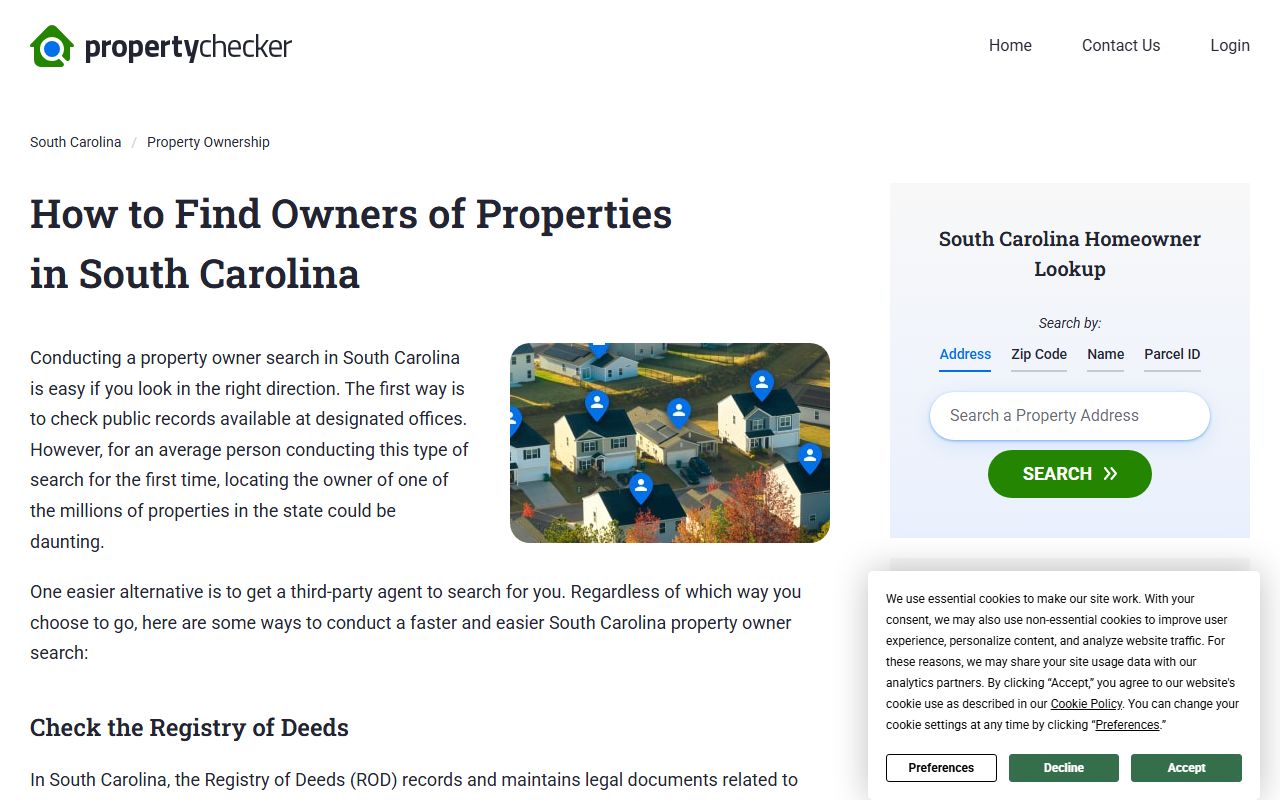
This tool can serve as a quick first step when you need to identify a current property owner before pulling the full deed record from the county recording office.
For those who conduct regular searches, many county offices offer subscription plans that provide faster access and advanced search features. For occasional users, the free statewide portal at sclandrecords.com is usually sufficient for finding basic ownership information and document reference numbers tied to South Carolina deed records.
Browse South Carolina Deed Records by County
Each of South Carolina's 46 counties maintains its own deed records. Select a county to find the recording office, search tools, and resources for deed records in that area.
South Carolina Deed Records by City
Deed records for cities are held by the county Register of Deeds or Clerk of Court. Pick a city to find the correct recording office for that area.