
Charleston County Deed Records and Historical Land Documents
Charleston County holds the oldest deed records in South Carolina, with documents dating back to 1719. The elected Register of Deeds, formerly known as the Register of Mesne Conveyances, operates from the O.T. Wallace County Office Building in downtown Charleston. The office records deeds, plats, mortgages, liens, and dozens of other instrument types for this large and historic coastal county. An online portal covers records from 1979 to the present. Older records, including a Historical Books collection spanning 71 series from 1719 to 1959, are accessible through the Archival Room. Charleston County's land record repository is the most historically significant in the entire state.
Charleston County Quick Facts
Charleston County Register of Deeds Office
The Charleston County Register of Deeds is one of only six elected Registers in South Carolina. The office sits in the O.T. Wallace County Office Building at 101 Meeting Street, Suite 150, Charleston. Office hours run Monday through Friday from 8:30 AM to 5:00 PM. The main phone number is (843) 958-4800 and the fax is (843) 958-4804. Document requests may also be submitted by email to mtorres@charlestoncounty.org.
The Charleston County Register of Deeds official website provides access to the online search portal, the fee schedule, and information about the Archival Room. The office maintains a public search room with computer terminals for in-person searches. Staff are available during business hours to assist with document requests and search guidance.
| Office | Charleston County Register of Deeds |
|---|---|
| Address | 101 Meeting Street, Suite 150, Charleston, SC 29401 |
| Phone | (843) 958-4800 |
| Fax | (843) 958-4804 |
| Hours | Monday - Friday, 8:30 AM - 5:00 PM |
| Website | charlestoncounty.org/rod |
The screenshot below shows the Charleston County Register of Deeds official website, which links to the online search portal and provides detailed guidance on recording services, fees, and archival access.
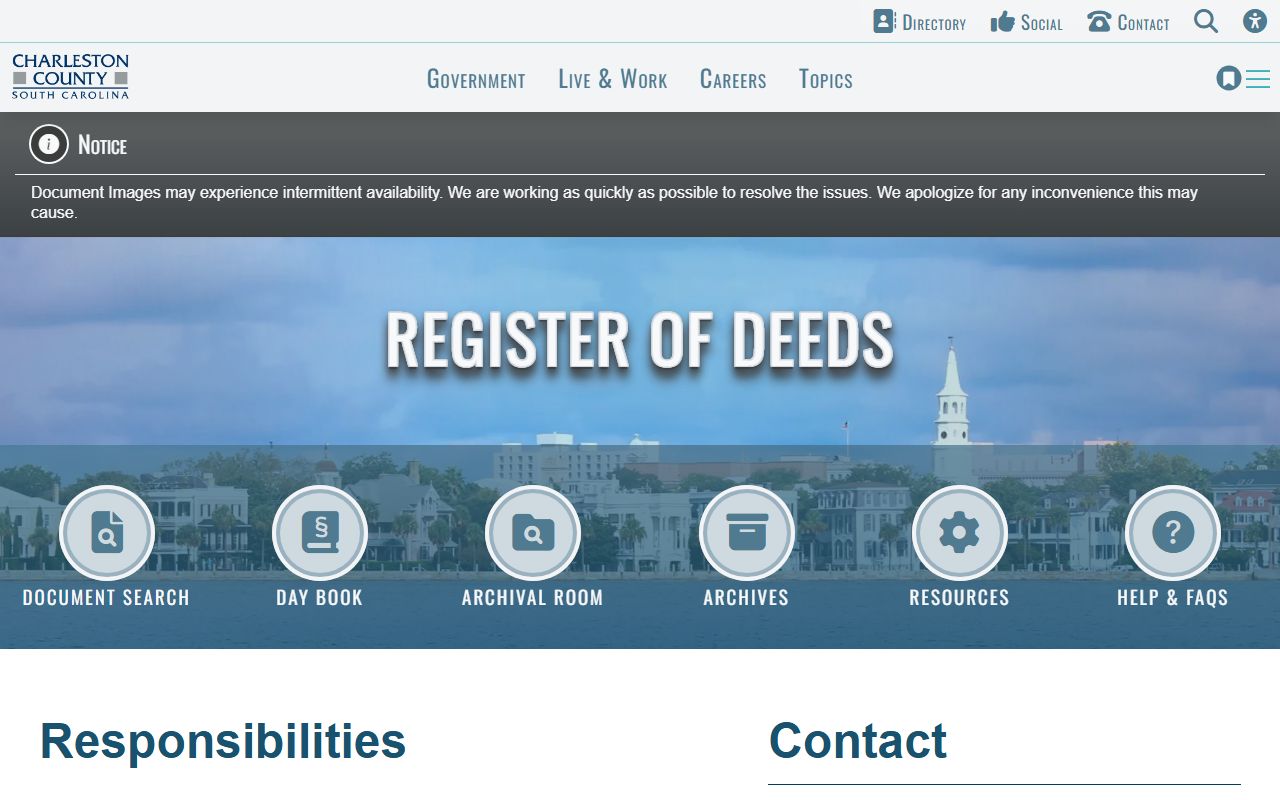
The site also explains the Archival Room access process for historical records that predate the digital search portal.
Online Search Tools for Charleston County Deed Records
The official online portal for Charleston County supports searches by name and date, document type and date, book and page, new book and new page, and tracer number. It covers records from 1979 to the present and is the main tool for title professionals and property researchers working with modern instruments. The portal is accessible through the Register of Deeds website and does not require a login for basic searches.
The Charleston County Public Index provides a broader name-based search covering both court and deed records. This tool is widely used by attorneys and title companies who need to identify all recorded instruments for a given individual or entity. For property research that goes beyond deed records, CharlestonRecords.org pulls together property records, court case data, tax and assessment information, interactive parcel maps, and foreclosure auction lists in a single directory.
The statewide SC Land Records portal also includes Charleston County documents. For researchers working across multiple counties, the statewide portal offers a unified search interface. For Charleston County specifically, however, the county's own portal and Public Index often provide faster and more complete results.
The image below shows the CharlestonRecords.org public records directory, which aggregates deed data, property tax records, court filings, and interactive maps for Charleston County property research.
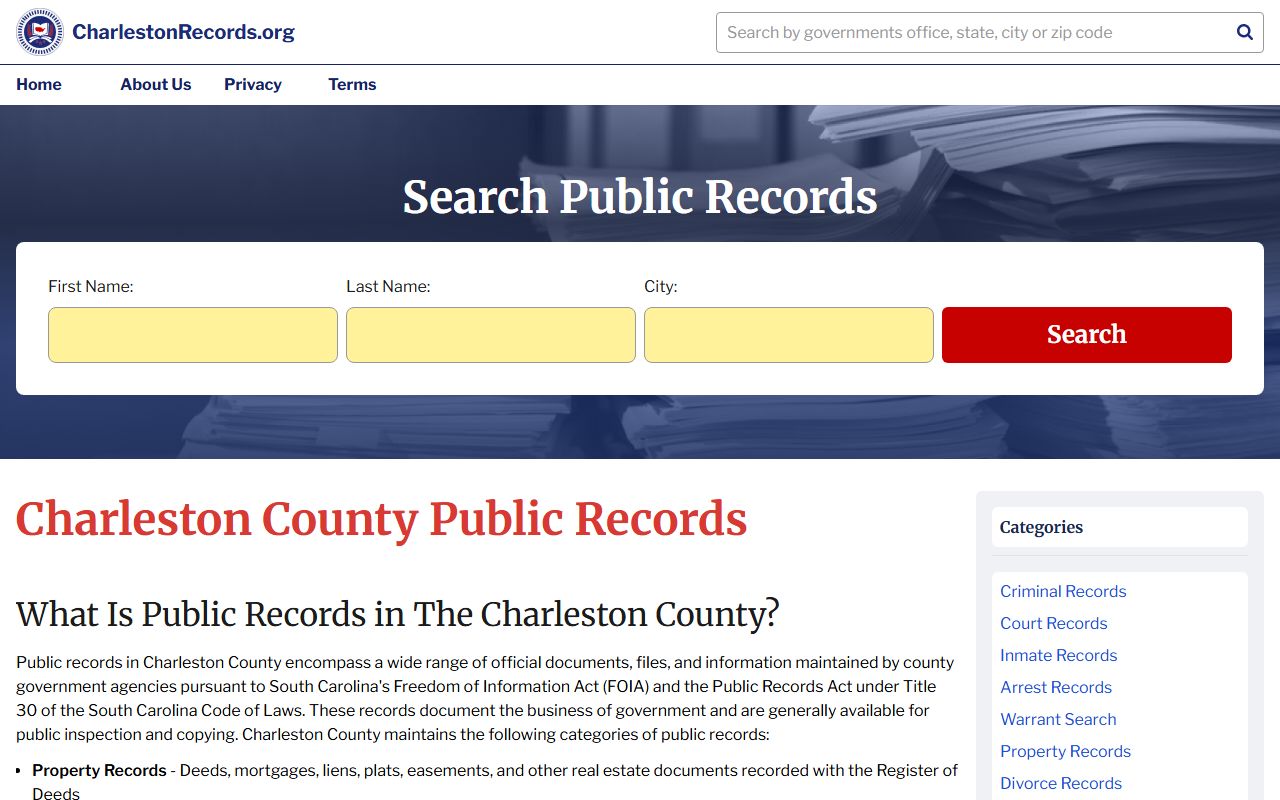
Using multiple tools together gives the most complete view of any Charleston County property's legal and ownership history.
Note: For deed records predating 1979, researchers should plan a visit to the Archival Room at the Register of Deeds or submit an advance request for specific historical instruments.Charleston County Public Index Search Portal
The Charleston County Public Index at jcmsweb.charlestoncounty.org/publicindex is one of the most capable free name-search tools available for any South Carolina county. It covers both court records and deed instruments and allows users to retrieve a list of all filings matching a party name. This is particularly useful for lien searches and for verifying whether a seller has any outstanding encumbrances on a property.
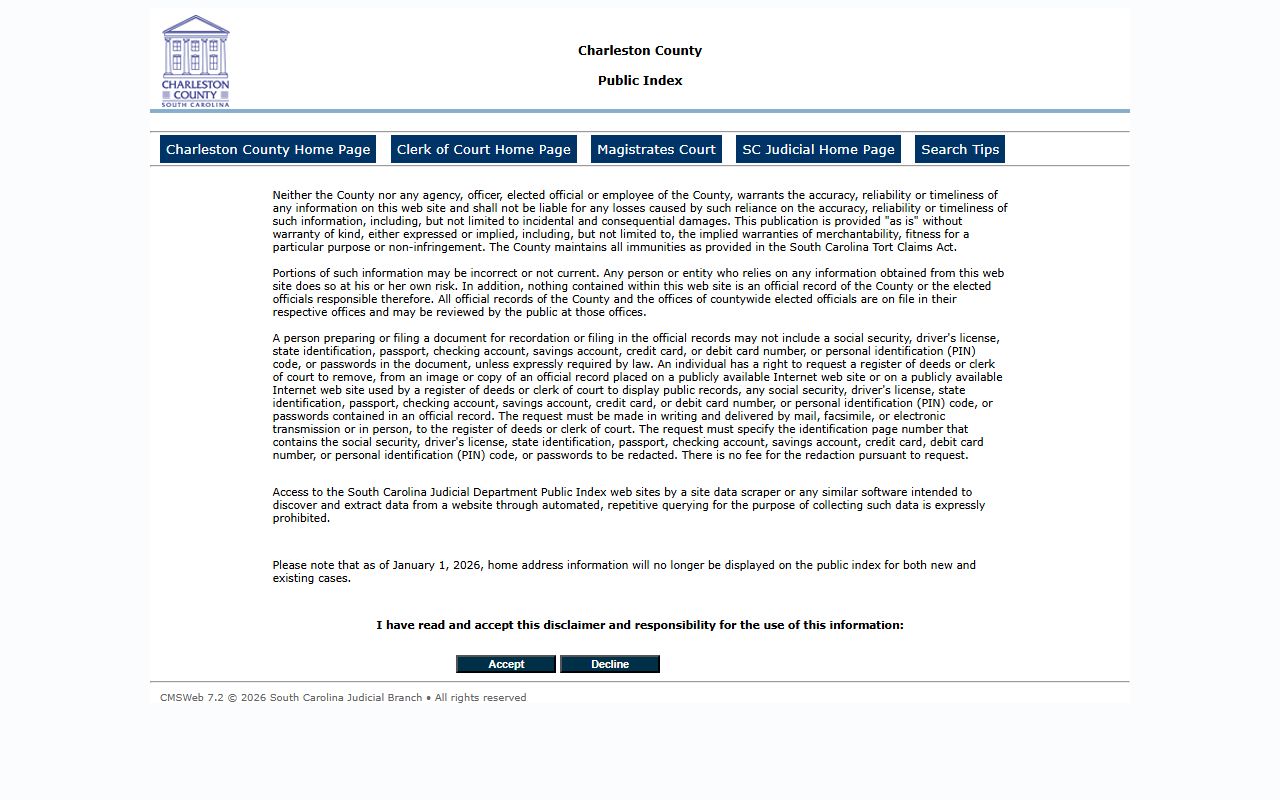
Title attorneys and real estate professionals in the Charleston area use the Public Index regularly as part of due diligence for property transactions throughout the county.
Historical Deed Records and the Archival Room
No county in South Carolina can match Charleston's depth of historical land records. The collection spans from 1719 to the present across 71 series of Historical Books covering the period from 1719 to 1959. The oldest documents include Conveyance Books from 1719 to 1776 and 1776 to 1785. The Public Register of the Province of South Carolina runs from 1735 to 1916. Dowers and Citizenship Petitions cover 1796 to 1905. Miscellaneous Records extend back to 1696. South Carolina wills and property records in the collection reach as far back as 1671.
The Archival Room at the Register of Deeds office holds digitized historical plats, including the McCrady Plats and Gaillard Plats. These are among the most frequently consulted historical map collections in South Carolina real property research. The McCrady Plats document land ownership and property boundaries in the Charleston area across multiple centuries. Access to the Archival Room is available to the public during regular office hours.
For additional historical resources, the South Carolina Department of Archives and History holds complementary state-level records. The OnGenealogy SC land records directory identifies which portions of the Charleston County historical record have been digitized or microfilmed for remote access. Genealogists tracing colonial-era land grants and post-Civil War property transfers will find Charleston County's records uniquely rich.
What Charleston County Deed Records Contain
Every deed recorded in Charleston County includes the grantor and grantee names and their addresses. A legal description of the property defines its exact boundaries, either in metes and bounds form or by reference to a recorded plat. The stated consideration appears on the face of the document. The recording date and instrument number are assigned at filing.
Deeds executed after July 1, 1976 must include a derivation clause under Section 30-5-35 of the state code. This clause names the prior deed or instrument through which the grantor received title, linking each transaction to the previous one in the chain. The grantee's mailing address is also required. Easements, deed restrictions, plat references, and HOA covenants may also appear in the deed body and become part of the permanent record. For historic properties in downtown Charleston or the sea islands, deed restrictions often include preservation or aesthetic requirements tied to historic district regulations.
Recording Fees and Requirements in Charleston County
All recording in Charleston County follows Title 30, Chapter 5 of the South Carolina Code. Section 30-5-30 requires acknowledgment by the grantor before a notary. Section 30-5-90 requires recording within 30 days of lodgment. The deed transfer fee under Section 12-24-10 is $1.85 per $500 of property value, and the grantor bears this cost.
The first-page recording fee in Charleston County is $15, with additional pages at $5 each. Copy fees are $0.50 per page. Document certification costs $10. These fees apply to all instruments filed at the main office. Lien recording in Charleston County follows Section 30-7-70, which governs filing requirements and priority among competing creditors. The SCIWAY recording directory at sciway.net includes Charleston County in its statewide guide to all 46 South Carolina recording offices.
Document Types Recorded in Charleston County
The Register of Deeds in Charleston County accepts the full range of real property instruments under South Carolina law. The county's status as the most populous in the state means the volume of filings is high across all document types. Warranty deeds, quitclaim deeds, and deeds of gift are the primary deed types. Mortgages and deeds of trust are filed by lenders. Plats document subdivision and parcel boundaries.
Additional instrument types include mechanics liens, tax liens, UCC financing statements, powers of attorney, trusts, death certificates, and notice of partnerships. The broad range reflects Charleston County's diverse real estate economy, which includes residential, commercial, historic preservation, and maritime property transactions.
- Warranty deeds, quitclaim deeds, and deeds of gift
- Mortgages and deeds of trust
- Plats, subdivision plats, and boundary surveys
- Mechanics liens and tax liens
- UCC financing statements
- Powers of attorney, trusts, and death certificates
Public Access and Privacy Rights in Charleston County
All deed records in Charleston County are public under S.C. Code Section 30-4-10, the South Carolina Freedom of Information Act. Any person may view or request copies of any recorded instrument without providing a reason. The Register of Deeds must provide this access during regular business hours. The public search room at the main office provides computer terminals for in-person access to the digital index and document images without staff assistance.
Privacy rules allow any person to request removal of their Social Security number from internet-accessible copies of recorded documents. If such a number appears on a deed or other instrument filed in Charleston County, the affected individual may contact the Register of Deeds at mtorres@charlestoncounty.org to request digital redaction. The physical paper record is not changed. The SC Property Checker for Charleston County is a supplemental tool for quick ownership and deed history lookups that may save time before pulling full document images from the official portal.
Nearby Counties
Charleston County anchors the South Carolina Lowcountry and shares boundaries with several neighboring counties, each maintaining its own recording office for deed records.