
Fairfield County Deed Records and Property History
Fairfield County deed records extend back to 1785, placing this Midlands county among the oldest recording jurisdictions in South Carolina. The Clerk of Court in Winnsboro handles all real property recording for the county, maintaining deeds, mortgages, plats, and other land instruments that form the public title record. Searching Fairfield County deed records gives access to centuries of property ownership history alongside current transactions. Online tools and the county courthouse both provide routes to the deed records, and the South Carolina Archives holds the earliest historical collections for researchers tracing property ownership across generations.
Fairfield County Quick Facts
Fairfield County Recording Office and How Records Are Kept
The Fairfield County Clerk of Court handles all real property recording in the county. Like many South Carolina counties, Fairfield assigns recording duties to the Clerk of Court rather than a separate Register of Deeds. The Clerk accepts deed submissions, collects recording fees, stamps documents with the date and instrument number, and maintains the public deed books and indexes.
The Fairfield County Government website provides contact information for the Clerk of Court and links to available county services. Researchers planning an in-person visit should check the site for current hours and any submission requirements that may have changed.
Recording fees in South Carolina are set statewide at $1.85 per $500 of consideration under Section 12-24-10. The Clerk collects this fee at the time a deed is submitted. Under Title 30, Chapter 5, a deed must be acknowledged before recording, and any deed recorded after July 1, 1976 must include a derivation clause and the grantee's address per Section 30-5-35.
Historical Fairfield County Deed Records
Fairfield County's historical property record collections span more than two centuries. The county was established in 1785, and deed recording began in the same year. These early records document land grants, plats from the original county surveys, and property transfers during the formative decades of South Carolina statehood.
The South Carolina Department of Archives and History holds the following historical Fairfield County series:
- Deed Records 1785–1902
- Dower Estates 1870–1895
- Fairfield County Records Book T
- Homestead Estates 1871–1879
- Mortgages of Real Estate 1872–1904 with Index 1872–1918
- Plat Books 1785–1841
- Real Estate Records 1836–1878
- Record of Estrays 1788–1799
The SC Department of Archives and History online research portal is the best starting point for accessing these older collections.
Fairfield County Government official website for public records and county services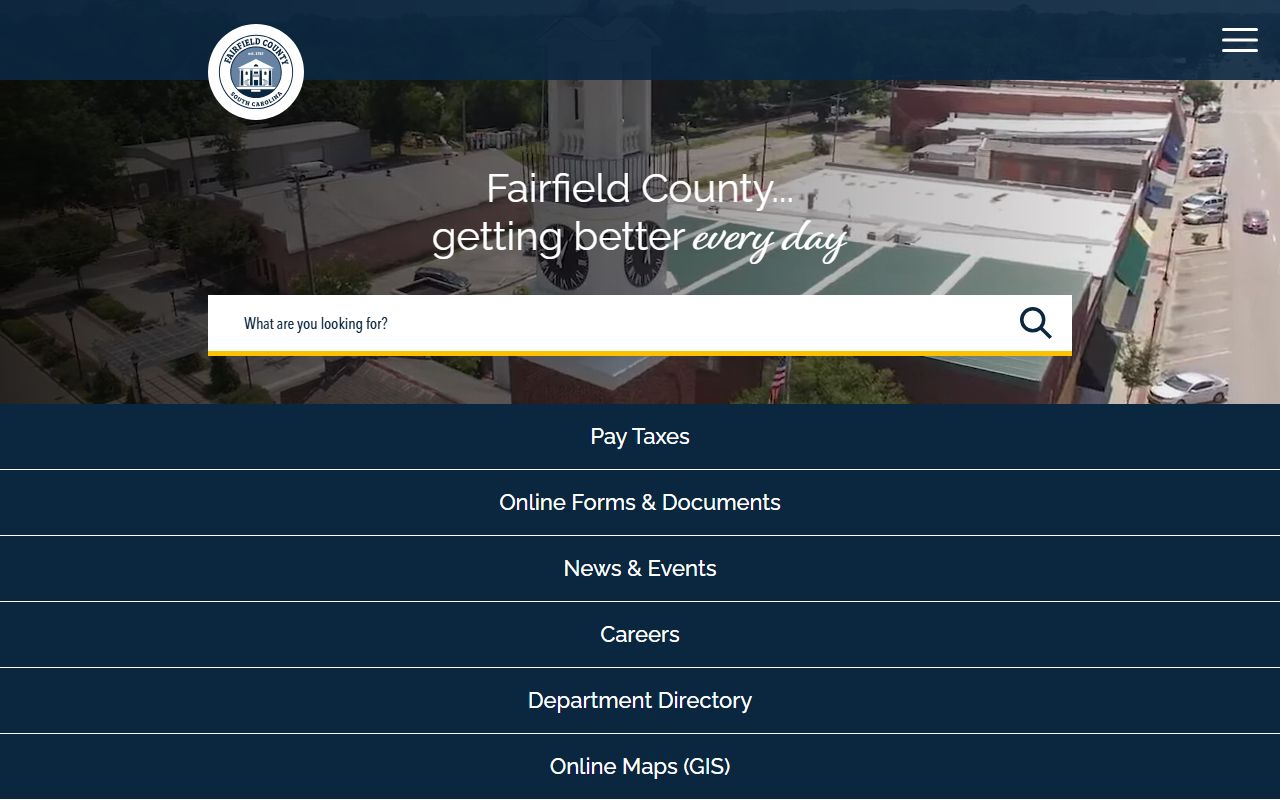
The county website connects researchers to current recording office information and online services alongside the historical records available through state archives.
Note: The Dower Estates and Homestead Estates series are especially valuable for post-Civil War research, documenting legal procedures that affected land ownership during Reconstruction.
Searching Fairfield County Deed Records Online
Online tools make Fairfield County deed records accessible without a courthouse visit. SC Property Checker Fairfield County aggregates property and deed data, allowing searches by owner name or address to find recorded documents for specific parcels.
SC Property Checker Fairfield County showing deed records and property data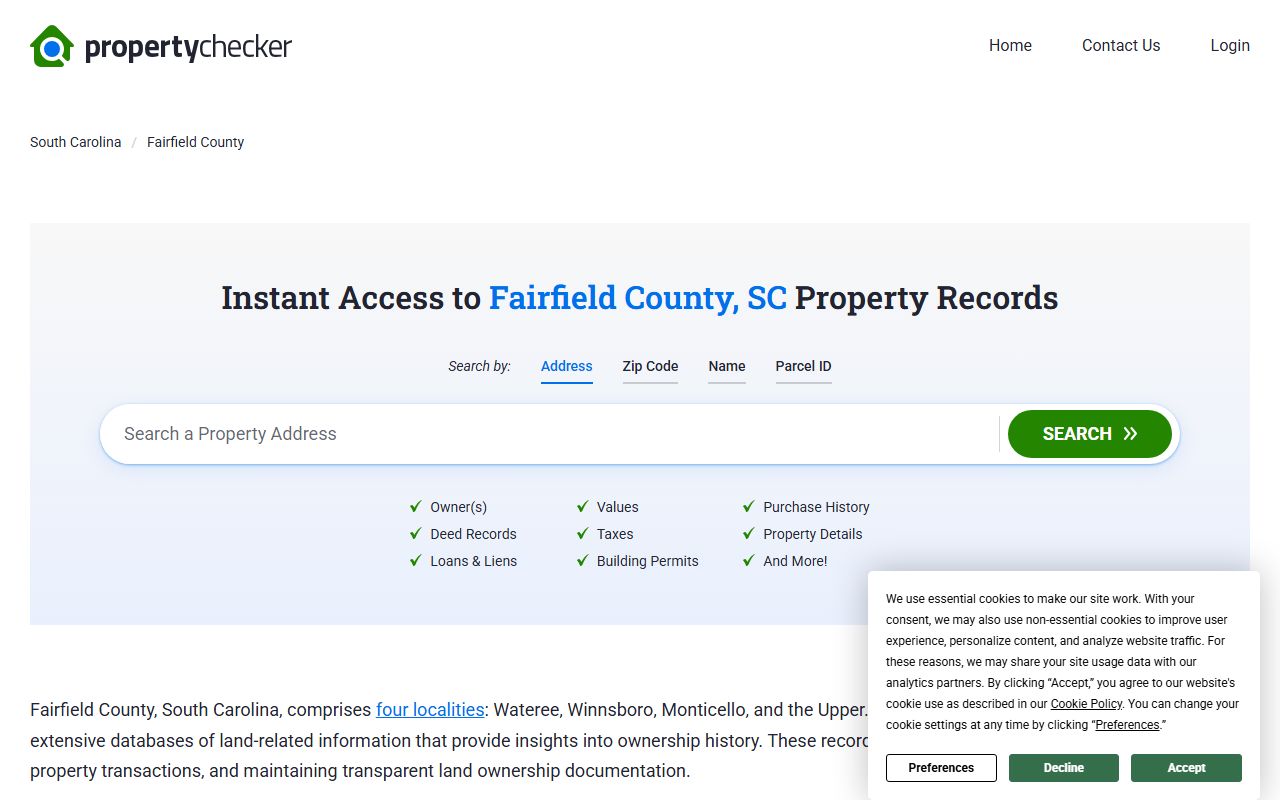
The tool provides deed history, ownership information, and links to associated recorded instruments for parcels throughout Fairfield County.
The statewide SC Land Records portal provides another online access route for Fairfield County deed documents. For historical research, the OnGenealogy South Carolina land records directory catalogs available online collections by county and time period, helping researchers identify which Fairfield County records are digitized versus available on microfilm only.
The SCIWAY recording offices directory lists current contact information for the Fairfield County Clerk of Court.
What Fairfield County Deed Records Show
A recorded deed in Fairfield County includes the grantor and grantee names and addresses, a legal description of the property, the consideration amount, the recording date, and the instrument number. Modern deeds also carry the derivation clause required under Section 30-5-35 and the grantee's mailing address.
For researchers working with older Fairfield County deed books, the legal descriptions often use metes and bounds surveying, referencing named neighbors, creeks, and other landmarks that have changed over time. These descriptions can be challenging to interpret without knowledge of historical surveying practices and local geography. Comparing a deed description with contemporary plat maps helps locate the land being described.
Beyond deeds, the Clerk of Court maintains mortgages recording liens on property, plat books showing subdivision layouts and individual parcel boundaries, mechanics liens, tax liens, and other instruments. The Mortgages of Real Estate series from 1872 to 1904 shows historical borrowing patterns, while the more recent mortgage index covers contemporary lending against Fairfield County real property.
Fairfield County Deed Records and South Carolina Recording Law
All deed recordings in Fairfield County must comply with state law. Section 30-5-30 requires acknowledgment of the grantor's signature before recording. Section 30-5-35 adds the derivation clause and grantee address requirements for post-1976 deeds. Section 30-5-90 requires the Clerk to record lodged documents within 30 days, though most are processed the same day.
Priority between competing deeds is determined by recording order. The deed recorded first prevails over a later deed to the same property. Under Section 30-7-70, recording provides constructive notice to all subsequent buyers and creditors. Once a deed is in the public record, no one can claim they did not know about the prior conveyance.
This recording system protects both buyers and sellers in Fairfield County property transactions. A buyer who searches the deed indexes before closing can confirm that the seller holds clear title and that no prior recorded claims exist against the property. The public nature of deed records is the foundation of the entire system.
Using Fairfield County Deed Records for Genealogy
Genealogists find Fairfield County deed records especially productive given the depth of the collection. Records from 1785 forward allow researchers to trace family land ownership across more than two centuries. Early deed books often list neighboring landowners by name, creating informal family maps that show where relatives settled in relation to one another.
The Dower Estates records from 1870 to 1895 document the legal process by which a widow relinquished her dower right in land being sold. These records name the widow, the deceased husband, the buyer, and the property, providing a direct family connection not always found in deed books alone. Combined with probate records and the deed books themselves, the Dower Estates series fills important gaps in family histories.
Plat Books from 1785 to 1841 are among the oldest cartographic records for Fairfield County. These early plats show the original layout of land in the county, including the names of early settlers and the boundaries of their grants. Researchers comparing an early plat with a later deed can trace how a single large tract was subdivided over generations.
Note: The Record of Estrays from 1788 to 1799 — while not a deed record — is kept with early county land records and occasionally names landowners who can be cross-referenced in the deed books from the same period.
Public Access to Fairfield County Deed Records
Fairfield County deed records are public under the South Carolina Freedom of Information Act, S.C. Code Section 30-4-10. Any person can inspect or copy recorded instruments. The Clerk of Court provides access to deed books, grantor and grantee indexes, and microfilmed records during regular business hours.
Social Security numbers in online deed records can be redacted from the digital image upon request, without altering the physical record. This protection is available for any recorded document containing an SSN that is accessible online.
Title attorneys, lenders, and real estate professionals rely on Fairfield County deed records to confirm ownership and identify encumbrances before every property closing. The long history of recorded deeds in Fairfield County means that even straightforward title searches can require reviewing instruments spanning multiple decades or longer.
Nearby Counties
Fairfield County is surrounded by Richland, Lexington, Newberry, Union, and Chester counties, all of which maintain their own recording offices.