
Lee County Deed Records and Property Document Search
Lee County deed records are maintained by the Clerk of Court in Bishopville, South Carolina. Lee County uses the Clerk of Court office to perform all real property recording functions, including the recording of deeds, mortgages, plats, and liens. One of South Carolina's smaller counties by area and population, Lee County sits in the Pee Dee and Sandhills region between Sumter and Darlington. Whether you are researching a title, tracing property ownership, or searching for a recorded instrument, the Clerk of Court in Bishopville is the official source. All records are public under South Carolina law.
Lee County Quick Facts
Where Lee County Deed Records Are Kept
Lee County is one of the South Carolina counties where the Clerk of Court serves as the recording authority for all real property instruments. The Clerk of Court records warranty deeds, quitclaim deeds, mortgages, plats, liens, and other documents that affect title to land within the county. Each document filed with the Clerk is indexed by grantor and grantee name and assigned an instrument number and recording date. The Clerk's office is the single authoritative repository for all Lee County land records.
The Lee County Government website provides information about county offices and contact information. The county seat of Bishopville has served as the administrative center of Lee County since the county was established. In-person access to deed records is available at the Clerk of Court during regular business hours. The office staff can assist with document retrieval, recording submissions, and requests for certified copies of filed instruments.
| Office | Lee County Clerk of Court |
|---|---|
| County Seat | Bishopville, SC |
| Type | Clerk of Court (handles recording) |
| Hours | Monday - Friday, 8:30 AM - 5:00 PM |
| Website | leecountysc.org |
The Lee County Government website, shown below, includes office listings and contact details for the Clerk of Court, which is responsible for recording and maintaining all property instruments in the county.

The county website provides direct access to department contacts and services for residents needing to access or file property documents in Lee County.
Note: Lee County uses the Clerk of Court rather than a separate Register of Deeds to handle all real property recording, which is the arrangement used in 23 of South Carolina's 46 counties.How to Search Lee County Deed Records Online
Lee County deed records can be searched through several online resources. The SC Land Records portal provides free public access to recorded documents from participating South Carolina counties. Searches are available by grantor or grantee name, instrument type, or book and page reference. The availability of online records for Lee County may vary by year, and older instruments may require an in-person request at the Clerk of Court in Bishopville.
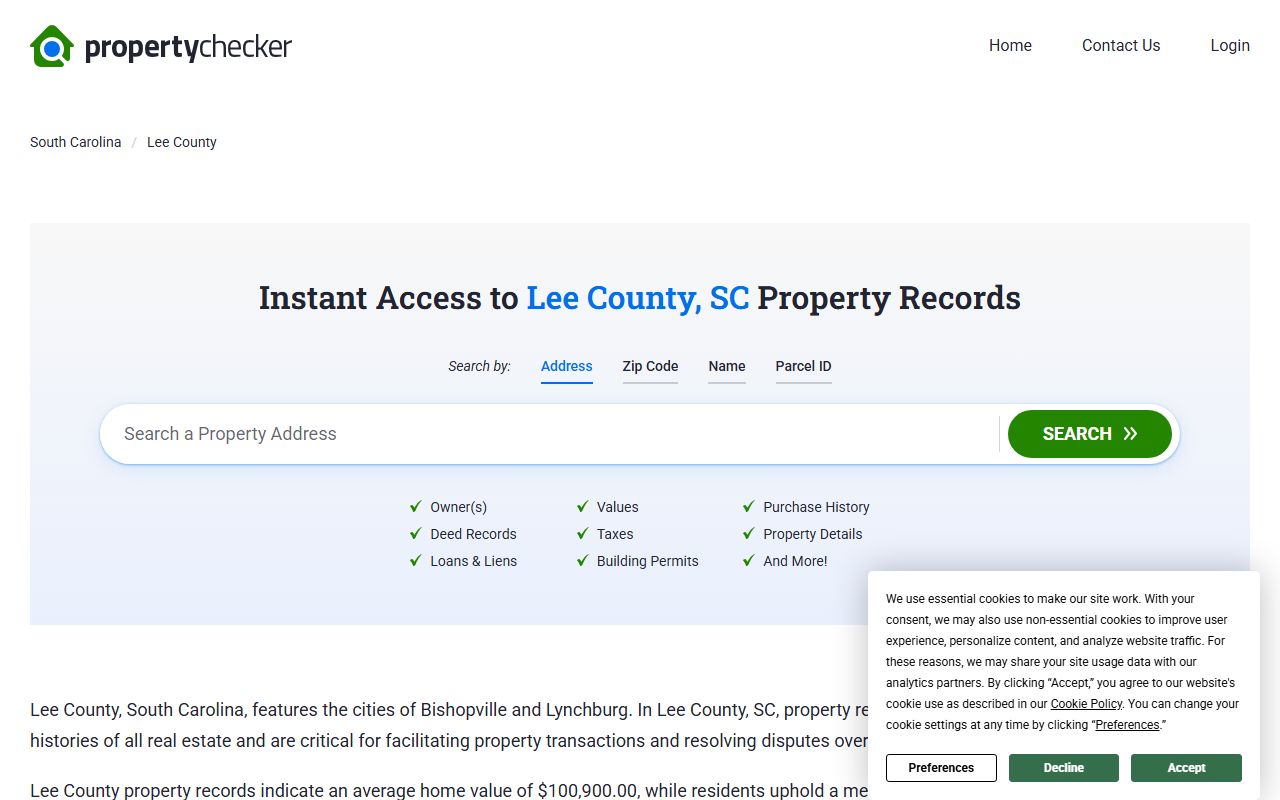
The SC Property Checker for Lee County provides a compiled view of property ownership and deed history for parcels throughout the county. This tool is useful for identifying the current owner, reviewing prior transfers, and checking parcel details without a courthouse visit. The SCIWAY county directory at sciway.net lists contact information and office links for recording offices in all 46 South Carolina counties, including Lee County.
The screenshot below shows the SC Property Checker tool for Lee County, presenting ownership records and deed data for property in and around the Bishopville area.
Reviewing online tools before visiting the Clerk of Court helps researchers confirm what documents exist before making a trip to Bishopville.
What Lee County Deed Records Contain
Each deed recorded in Lee County contains the standard required elements under South Carolina law. The grantor, meaning the conveying party, and the grantee, meaning the receiving party, are identified by name and mailing address. A legal description of the property is required, typically in metes and bounds form or by reference to a plat recorded with the county. The stated consideration reflects the value or price involved in the transaction. An instrument number and recording date are assigned at the time of filing.
South Carolina law requires under Section 30-5-35 that all deeds executed after July 1, 1976 include a derivation clause. This clause states how the grantor acquired title to the property, linking each deed in the chain of ownership to the previous transfer. The grantee's mailing address is also a required element. For parcels in Lee County, legal descriptions may reference older plat books covering rural tracts and smaller subdivisions throughout the county.
Other details that may appear on a Lee County deed include easements, deed restrictions, rights-of-way, and covenant language affecting the use of the property. Tax map numbers and plat book citations are commonly included. All of this information becomes part of the permanent public record once the document is filed with the Clerk of Court.
Note: Lee County deed records for older rural tracts may include metes and bounds descriptions that reference natural landmarks or older property lines, which can require careful interpretation during title research.Documents Recorded in Lee County
The Lee County Clerk of Court maintains a variety of real property instruments beyond basic deeds. Mortgages and deeds of trust are filed when a lender holds a security interest in real property. Plats are recorded separately and serve as the official boundary maps for parcels throughout the county. Judgment liens, tax liens, and mechanics liens are also part of the county's recording system and are available for public inspection.
The full range of documents filed in Lee County reflects the breadth of real property transactions in the area, from rural agricultural transfers to residential sales and commercial transactions. Understanding which document type is relevant to a particular search or filing saves time for both researchers and property owners.
- Warranty deeds and quitclaim deeds
- Mortgages and deeds of trust
- Plats and subdivision maps
- Judgment liens and tax liens
- Mechanics liens
- Powers of attorney
- Deeds of gift and corrective deeds
Recording Requirements for Lee County Deed Records
South Carolina recording requirements are established by Title 30, Chapter 5 of the state code. Section 30-5-30 requires that all deeds be acknowledged before a notary public or other authorized officer prior to recording. This acknowledgment confirms that the grantor signed the document voluntarily and that it is authentic. The Clerk of Court in Lee County will not accept a deed for recording unless this requirement has been satisfied.
The recording fee in South Carolina is set at $1.85 per $500 of stated property value under Section 12-24-10. The grantor is responsible for paying this fee. Per-page recording fees also apply, with the first page typically costing between $10 and $15 and additional pages at $5 each. Contacting the Lee County Clerk of Court directly to verify the current fee schedule is recommended before submitting any document. Once received, all documents must be recorded within 30 days under Section 30-5-90.
Lien recording in Lee County is governed in part by Section 30-7-70, which establishes the procedures and priority rules for liens. Timely recording provides constructive notice to all future purchasers and lenders, which is why the exact date and time of recording matter in any title or lien priority analysis.
Historical Deed Records in Lee County
Lee County was established in 1902, carved primarily from Darlington, Sumter, and Kershaw counties. As a relatively young county, Lee County's recording history begins in the early 1900s. Researchers tracing property ownership in the county before 1902 will need to consult the predecessor county records, particularly those from Sumter County, Darlington County, and Kershaw County. Early title searches in Lee County often require working across these older county archives to establish a complete chain of title.
The South Carolina Department of Archives and History holds materials from across the state, including records from the predecessor counties that covered Lee County's area before 1902. Genealogical researchers and title examiners can find plat records, early deed abstracts, and historical land data through the Archives. Some of these materials have been digitized and are accessible online, reducing the need for an in-person visit for older research requests.
The Lee County Clerk of Court holds deed books and index records from the county's formation in 1902 through the present. Combining the Clerk's holdings with the Archives and online research tools provides the most thorough approach to historical property research in Lee County.
Note: Researchers tracing Lee County property ownership before 1902 will need to consult deed records from Sumter, Darlington, or Kershaw County, depending on which area the property was located in before the county was formed.Certified Copies and Fees in Lee County
Certified copies of Lee County deed records can be obtained from the Clerk of Court in person or by submitting a written mail request. A certified copy includes the official seal and signature of the Clerk of Court and is accepted as legal evidence of the recorded instrument. Uncertified photocopies are available at a lower per-page cost. Fee schedules are set by the county and may change over time; contacting the Clerk of Court before placing a request is the best way to confirm current pricing.
When requesting a specific document, include as much identifying information as possible. The grantor and grantee names, recording date, book and page number, and instrument number all help staff locate the correct record. For older or poorly indexed instruments, a property address or approximate recording date range may be necessary. Mail requests should include payment and a self-addressed stamped envelope for return delivery.
Public Access and South Carolina FOIA
All deed records filed with the Lee County Clerk of Court are public records. The South Carolina Freedom of Information Act, codified at S.C. Code Section 30-4-10, gives any person the right to inspect or receive copies of public documents. No reason is required when requesting deed records, and no special qualification is needed to access filed instruments. This open-access policy applies regardless of the age of the document or the identity of the requesting party.
South Carolina law provides a mechanism for removing Social Security numbers from the online versions of recorded documents. If a Social Security number appears on a deed or other instrument that is publicly viewable online, the affected individual may request redaction from the digital display. The physical paper record remains unchanged, but the online version will not show the number. This protection can be requested directly through the Lee County Clerk of Court office in Bishopville.
Nearby Counties
Lee County borders several South Carolina counties in the Pee Dee and Sandhills region, each with their own recording offices and deed record systems.