
Allendale County Deed Records and Property Filings
Allendale County deed records are maintained by the Clerk of Court in the town of Allendale, South Carolina. The Clerk handles all real property recordings, including deeds, mortgages, plats, and liens for this small rural county in the Lowcountry region. Allendale County was formed in 1919 and is one of the smaller counties in South Carolina by both area and population. Despite its size, the county maintains a complete and public record of all land transactions filed since its establishment. Records are open to anyone under state law.
Allendale County Quick Facts
Where to Find Allendale County Deed Records
The Allendale County Clerk of Court is the office of record for all real property instruments in the county. Because Allendale does not have a separate Register of Deeds, the Clerk performs the full recording function under South Carolina law. This includes receiving documents for filing, assigning instrument numbers, maintaining the grantor-grantee index, and providing public access to the records.
The Allendale County Government website lists contact information and services for county offices, including the Clerk of Court. If you need to file a deed or request a copy of a recorded document, starting with the county website is a good first step. In-person visits to the courthouse in Allendale are also an option for searching older records that may not be digitized.
| Office | Allendale County Clerk of Court |
|---|---|
| Address | 292 Barnwell Hwy, Allendale, SC 29810 |
| Phone | (803) 584-3742 |
| Hours | Monday - Friday, 9:00 AM - 5:00 PM |
| Website | allendalecounty.com |
The screenshot below is from the Allendale County Government website, which provides a starting point for accessing public records and county services.

The site covers the full range of county services and is the best starting point for first-time record requests.
Online Search Options for Allendale County Records
Searching Allendale County deed records online is possible through a few platforms. The statewide SC Land Records portal covers many South Carolina counties and allows searches by grantor name, grantee name, or document type. Coverage for smaller counties like Allendale may be limited for older date ranges, but recent filings are often accessible.
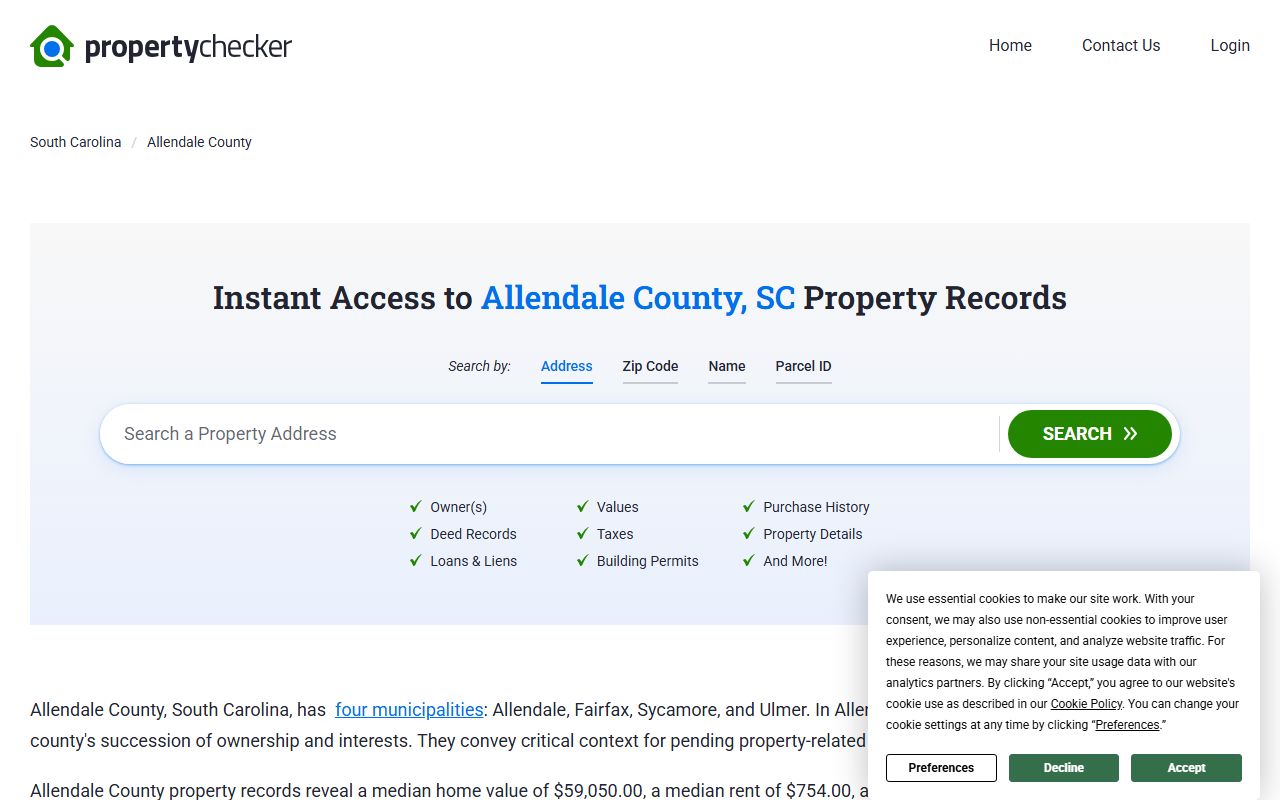
The SC Property Checker for Allendale County pulls deed and ownership data into a searchable format. You can look up properties by owner name or address and view deed history, transfer dates, and parcel details. For researchers who need quick access without an office visit, this tool offers a practical starting point. The SCIWAY directory at sciway.net also includes Allendale County in its statewide list of recording offices.
The image below shows the SC Property Checker tool for Allendale County, which displays deed records and property data for parcels in the county.
Online tools can often provide enough information to identify the recording date, book and page number, and parties involved in a transaction before any formal document request is made.
Note: For properties with older ownership histories, a visit to the Allendale County Clerk of Court may be necessary to view documents not yet available online.What Allendale County Deed Records Contain
A recorded deed in Allendale County follows the standard format required under South Carolina law. Both the grantor and grantee must be named with their addresses. The legal description of the land, written in metes and bounds or referenced to a recorded plat, defines the boundaries of the property being conveyed. The consideration, whether a cash amount or a nominal sum, appears on the face of the deed.
The recording date and the assigned instrument number are stamped on the document at the time of filing. For deeds executed after July 1, 1976, the derivation clause required under Section 30-5-35 of the South Carolina Code must reference the deed or instrument through which the grantor obtained title. The grantee's mailing address is also required by this same provision.
Documents may also include easements, deed restrictions, or references to covenants that run with the land. These encumbrances become part of the property's record and are disclosed to future buyers through the title search process. All of this information is preserved in the permanent record maintained by the Clerk of Court.
Document Types Filed in Allendale County
The Clerk of Court in Allendale County records a range of instruments related to real property. Warranty deeds are the most common type and provide the strongest form of title guarantee from seller to buyer. Quitclaim deeds transfer whatever interest the grantor holds without any warranty. Deeds of gift are used when property is transferred without a sale. All three types are recorded in the same manner and become equally public once filed.
Mortgages and deeds of trust are filed when a lender takes a security interest in real property. Plats show the boundaries and dimensions of a parcel and must be recorded before they can be referenced in a deed description. Mechanics liens give contractors and subcontractors a claim against property for unpaid work. Tax liens are filed when property taxes go unpaid. UCC financing statements are recorded for personal property security interests. Powers of attorney related to real estate transactions round out the types of instruments accepted by the office.
Recording Requirements Under South Carolina Law
All deeds filed in Allendale County must comply with the requirements of Title 30, Chapter 5 of the South Carolina Code. Section 30-5-30 requires acknowledgment or proof before recording. This means the grantor's signature must be witnessed by a notary public or another authorized officer. The acknowledgment confirms that the signature on the document is genuine and that the grantor executed it voluntarily.
The deed transfer fee set by Section 12-24-10 is $1.85 per $500 of the property's value. This is paid at the time of recording and is generally the responsibility of the grantor. A base recording fee also applies per page. For most deeds, the first page costs between $10 and $15, with additional pages at $5 each. Once submitted, the document must be recorded within 30 days under Section 30-5-90.
Liens recorded in Allendale County follow the rules of Section 30-7-70, which governs their filing and priority. Proper and timely recording protects all parties by establishing the official order in which interests in the property were created.
Accessing Older and Historical Records
Allendale County's history as a separate county begins in 1919. Records from before that date may be found in the records of Barnwell County, from which Allendale was created. Researchers working with early twentieth-century or older land records in this area should check both Allendale County's own holdings and those of Barnwell County.
For genealogists and historians, the South Carolina Department of Archives and History provides access to historical records and has digitized portions of the state's older land grant and deed records. The OnGenealogy South Carolina land records directory lists available digital resources by county and can help identify what has been microfilmed or indexed for Allendale and surrounding areas.
Copies and Certified Documents
Certified copies of Allendale County deed records are available from the Clerk of Court. A certified copy bears the official seal and the signature of the Clerk and is accepted in legal and financial proceedings as proof of the recorded instrument. Standard uncertified copies are also available and are sufficient for most research purposes. Fees for copies and certification are set by the county and should be confirmed with the office before submitting a request.
Requests can typically be submitted in person, by mail, or by phone. Providing the grantor and grantee names, the recording date, and the book and page number will speed up the process. For documents recorded in recent years, the instrument number can also be used to locate the record quickly.
Note: Mail requests for certified copies from the Allendale County Clerk of Court should include a check or money order and a self-addressed stamped envelope for the return of documents.Public Access Rights and Privacy
Deed records in Allendale County are open to the public under the South Carolina Freedom of Information Act at S.C. Code Section 30-4-10. Any person may view or request copies of recorded instruments without providing a reason. The law treats these records as part of the public domain, and no special permission is needed to access them.
One privacy protection that applies across South Carolina is the right to have a Social Security number removed from internet-accessible versions of recorded documents. If your Social Security number appears on a deed or other instrument filed in Allendale County, you may contact the Clerk of Court to request that it be redacted from any publicly available digital copy. The physical record remains intact.
Related County Property Records
Deed records are most useful when combined with other county data sources. The Allendale County Assessor maintains parcel records and tax valuations for all properties in the county. GIS data provides a visual map of parcel boundaries and can help identify a tract by its location. These resources, combined with the deed record, give a complete view of any given property's status and history.
Probate records are relevant when property is transferred through an estate. The Allendale County Probate Court handles estates and guardianships, and any real property conveyed through a probate proceeding is ultimately reflected in a deed filed with the Clerk of Court. Title searchers working on properties with multiple ownership generations will often need to consult both probate and deed records.
Nearby Counties
Allendale County is located in the southern part of South Carolina and borders several Lowcountry counties with their own recording offices.