
Hampton County Deed Records and Property Search
Hampton County deed records are maintained by a separate Register of Deeds office located in Hampton, the county seat of this Lowcountry South Carolina county. The Register accepts and records all real property instruments for the county, including deeds, mortgages, plats, and other documents affecting land title. Searching Hampton County deed records provides access to property ownership history, legal descriptions, and recorded encumbrances. Online tools and state portals provide access to Hampton County deed records, and in-person research is available at the Register of Deeds office during regular business hours.
Hampton County Quick Facts
Hampton County Register of Deeds Office
The Hampton County Register of Deeds operates as a separate office from the Clerk of Court. This office handles all real property recording for Hampton County, accepting deeds, mortgages, plats, liens, UCC filings, and other instruments. The Register assigns each document an instrument number, stamps the recording date and time, and maintains both physical and digital records for public access.
Contact information for the Hampton County Register of Deeds is available through the Hampton County government website. State resources including the SCIWAY recording offices directory also list the Register's address and phone number for researchers who need to reach the office directly.
All recordings in Hampton County must comply with South Carolina law. Under Title 30, Chapter 5, deeds must be acknowledged before a notary or other authorized officer before being accepted for recording. The recording fee of $1.85 per $500 of consideration applies under Section 12-24-10. Documents recorded after July 1, 1976 must include the derivation clause and grantee address required by Section 30-5-35.
Note: If the Hampton County government website is unavailable, use SCIWAY and the SC Land Records portal for contact information and record access.
Searching Hampton County Deed Records Online
Online access to Hampton County deed records is available through several platforms. For property-specific information and deed history, SC Property Checker Hampton County provides a searchable database tied to individual parcels.
SC Property Checker Hampton County showing deed records and property ownership information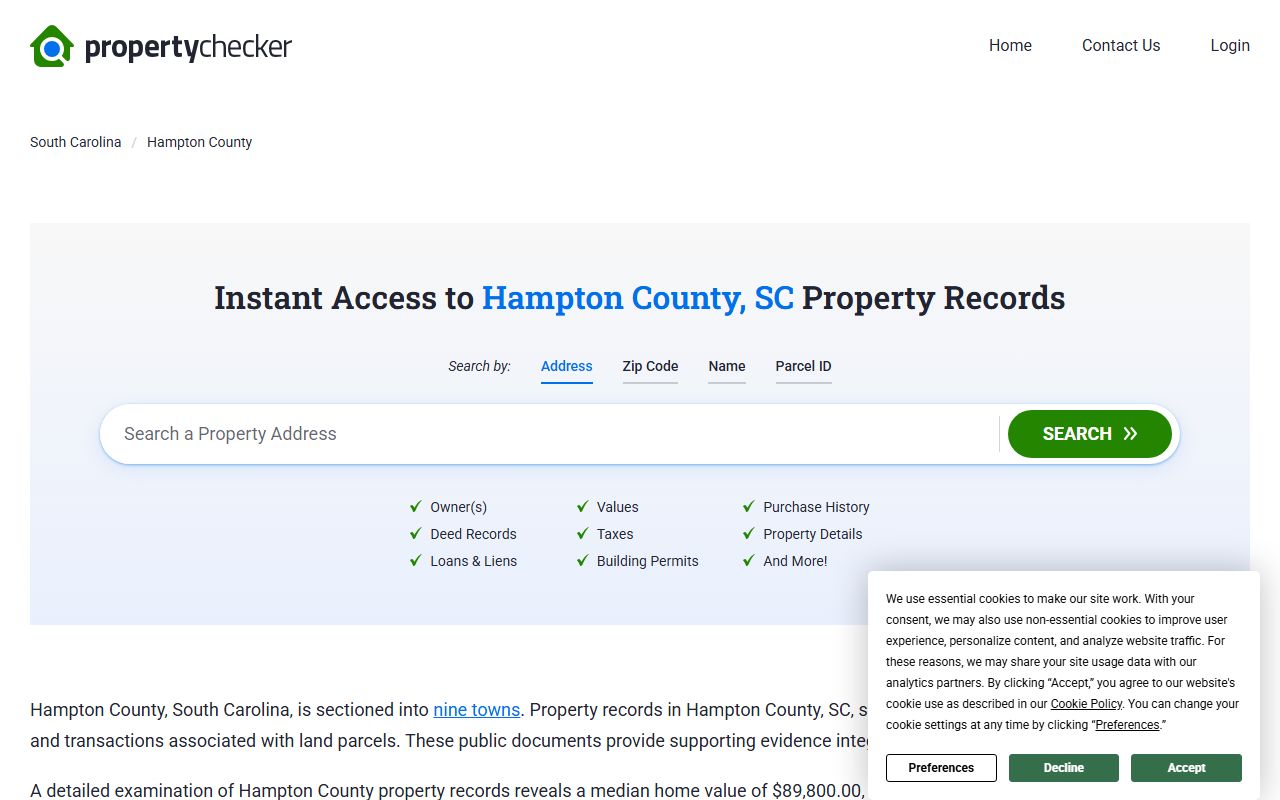
SC Property Checker lets you search Hampton County deed records by owner name or address and view the history of recorded instruments tied to specific properties.
For direct access to the county recording system and contact information, the SCIWAY directory provides a reliable alternative when the county government website is not available.
SCIWAY directory listing Hampton County Register of Deeds and South Carolina recording resources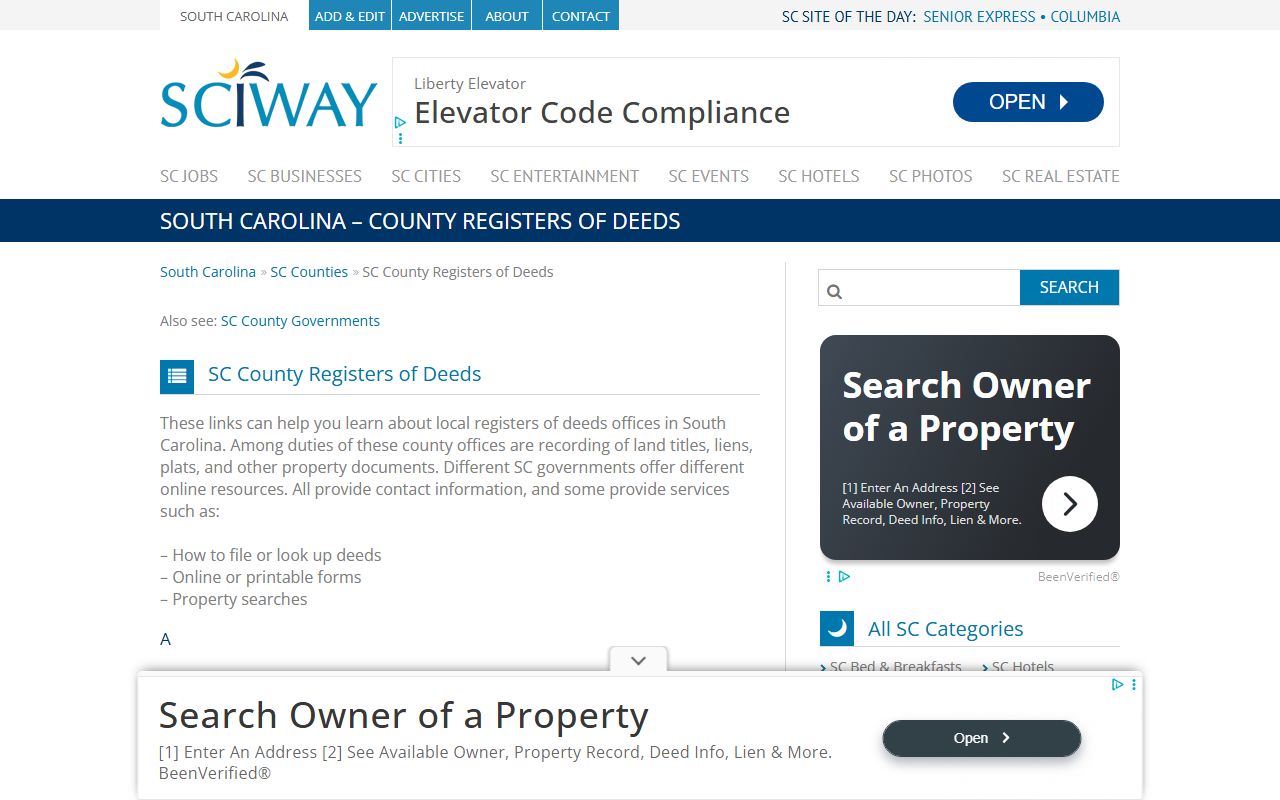
The SCIWAY listing for Hampton County includes contact details for the Register of Deeds office and links to state-level deed record resources.
The statewide SC Land Records portal also provides access to Hampton County recorded instruments. For historical research, the SC Department of Archives and History holds microfilmed Hampton County deed books and historical land records.
What Hampton County Deed Records Contain
Every recorded deed in Hampton County includes the grantor and grantee names and addresses, the legal description of the property, the consideration paid, the recording date, and the instrument number. Deeds executed after July 1, 1976 must also include a derivation clause showing how the grantor acquired the property and the grantee's mailing address, as required by Section 30-5-35.
The legal descriptions in Hampton County deeds reflect the county's largely rural character. Many parcels are described by metes and bounds measurements, with references to roads, creeks, and neighboring landowners. Newer subdivisions use plat references that tie the description to a recorded survey. Either method is valid under South Carolina law, provided the description identifies the land with sufficient certainty.
Beyond standard warranty and quitclaim deeds, Hampton County deed records include mortgages showing liens on real property, plat maps defining parcel boundaries and subdivision layouts, mechanics liens from contractors, federal and state tax liens, and UCC filings securing interests in personal property attached to real estate. All of these instruments become part of the public title record once recorded.
Types of Documents in Hampton County Deed Records
Warranty deeds are the most common instrument recorded in Hampton County for standard property sales. The grantor in a warranty deed covenants that they own the property, have the right to convey it, and will defend the grantee's title against all claims. These promises make warranty deeds the standard choice for arm's-length transactions between unrelated parties.
Quitclaim deeds convey only whatever interest the grantor holds, with no warranties. They appear frequently in family transfers, divorce property divisions, and corrections of technical title defects. Mortgage instruments, both original loans and refinances, are recorded to create public notice of the lender's lien. When a loan is satisfied, a discharge or release of mortgage is recorded to clear the lien from the title.
Plats are recorded when a tract of land is surveyed and divided into lots for a subdivision. The recorded plat becomes the reference for all subsequent deeds conveying lots within the subdivision. Mechanics liens are filed by contractors, subcontractors, or materialmen who have performed work or supplied materials for improvements to real property. These liens must be properly filed and foreclosed within statutory time limits or they expire.
South Carolina Recording Law and Hampton County Deeds
South Carolina recording law applies uniformly to all Hampton County deed recordings. The acknowledgment requirement of Section 30-5-30 is mandatory — a deed without proper acknowledgment will not be accepted for recording. The derivation clause and grantee address requirements of Section 30-5-35 apply to all deeds recorded after July 1, 1976.
Section 30-5-90 requires the Register to record a document within 30 days of lodgment. Priority between competing instruments is determined by the order in which they are recorded. A deed recorded first takes priority over a later deed to the same property, even if the later deed was signed before. This rule makes prompt recording essential for any Hampton County buyer or lender.
The constructive notice rule under Section 30-7-70 means that once a deed is in the public record, all subsequent parties dealing with that property are presumed to know about it. A buyer who fails to search the deed indexes cannot later claim they were unaware of a prior recorded deed. This rule is the foundation of South Carolina's recording system and applies fully in Hampton County.
Hampton County Deed Records and Property History
Hampton County was established in 1878 from Beaufort County, making it one of the newer counties in the Lowcountry. Property records for land within current Hampton County boundaries before 1878 are found in Beaufort County deed books at the state archives. After the county's formation, the Register of Deeds began building its own series of deed books.
The county's location in the Lowcountry means that land history often involves large tracts that were historically used for agriculture. Post-Civil War deed records in Hampton County document the breakup of large plantation holdings and the transfer of land to individual buyers. These records are important for understanding the economic and social history of the region.
For older Hampton County land records, the South Carolina Department of Archives and History is the primary resource. The Archives holds microfilmed deed books and historical plat records for the county, available for in-person and online research.
Genealogical researchers tracing Hampton County families in deed records should also check Beaufort County records for property history predating 1878. Deed records from both counties, combined with census data and probate files, build comprehensive family property histories for this Lowcountry region.
Note: The OnGenealogy South Carolina land records directory catalogs available online collections for Hampton County and provides guidance on which records are digitized versus available on microfilm only at the Archives.
Public Access to Hampton County Deed Records
Hampton County deed records are public under the South Carolina Freedom of Information Act, S.C. Code Section 30-4-10. Any person may inspect or copy recorded instruments without providing a reason. The Register of Deeds provides access during regular business hours, and online platforms extend access beyond courthouse hours for many document types.
Social Security numbers visible in online deed images may be redacted from the digital copy upon request. The physical record at the Register of Deeds is not changed, but the online image can be masked to protect personal information. This option is available to anyone whose SSN appears in a Hampton County recorded document accessible online.
Title attorneys, lenders, real estate agents, and private researchers all rely on the public nature of Hampton County deed records. A thorough title search draws on deed indexes, mortgage records, lien files, and plat books to give a complete picture of a property's ownership history and current encumbrances.
Nearby Counties
Hampton County borders Allendale, Barnwell, Beaufort, Jasper, and Colleton counties in the Lowcountry and coastal plain regions of South Carolina.