
Edgefield County Deed Records and Historical Land Files
Edgefield County deed records go back to 1787, giving this Midlands county one of the longest property record histories in South Carolina. The county maintains a separate Register of Deeds office in the town of Edgefield, which serves as the county seat. Searching Edgefield County deed records provides access to property ownership history, legal descriptions, mortgage instruments, plats, and historical land documents from the early statehood era. Both online and in-person research options are available, and the county's historical collections are accessible through the South Carolina Archives for records predating modern digital indexes.
Edgefield County Quick Facts
Edgefield County Register of Deeds Office
The Edgefield County Register of Deeds operates as a separate office from the Clerk of Court, handling all real property recording for the county. Located in the town of Edgefield, the office records deeds, mortgages, plats, liens, and other instruments that affect title to land. The Register assigns instrument numbers, stamps the recording date, and maintains both physical deed books and digital indexes for public research.
The Edgefield County government website provides access to office contact information and links to available online services. Researchers should consult the county website for current hours and submission requirements before visiting in person.
Recording fees follow the statewide schedule. The transfer fee is $1.85 per $500 of consideration under Section 12-24-10. Documents must meet state requirements for acknowledgment, legal description, and derivation clause before the Register will accept them for recording. Under Title 30, Chapter 5, acknowledgment before a notary is mandatory.
Historical Edgefield County Deed Records
Edgefield County's historical deed collections are among the richest in South Carolina. The county's recorded history stretches back to 1787, just two years after South Carolina began organizing its county system. These early records document the original transfer and division of land in the region, often referencing colonial-era grants and surveys.
The following historical series are held by the South Carolina Department of Archives and History and accessible through their research collections:
- Deeds 1787–1866, with Index to Deeds 1787–1869
- Forfeited Land Records 1871–1878
- Indexes to Deeds 1786–1913
- Plat Book 10 from 1951–1955
- Real Estate Mortgage Books 1872–1923
The SC Department of Archives and History online research portal is the primary access point for these records.
SC Department of Archives and History with Edgefield County historical deed records dating to 1786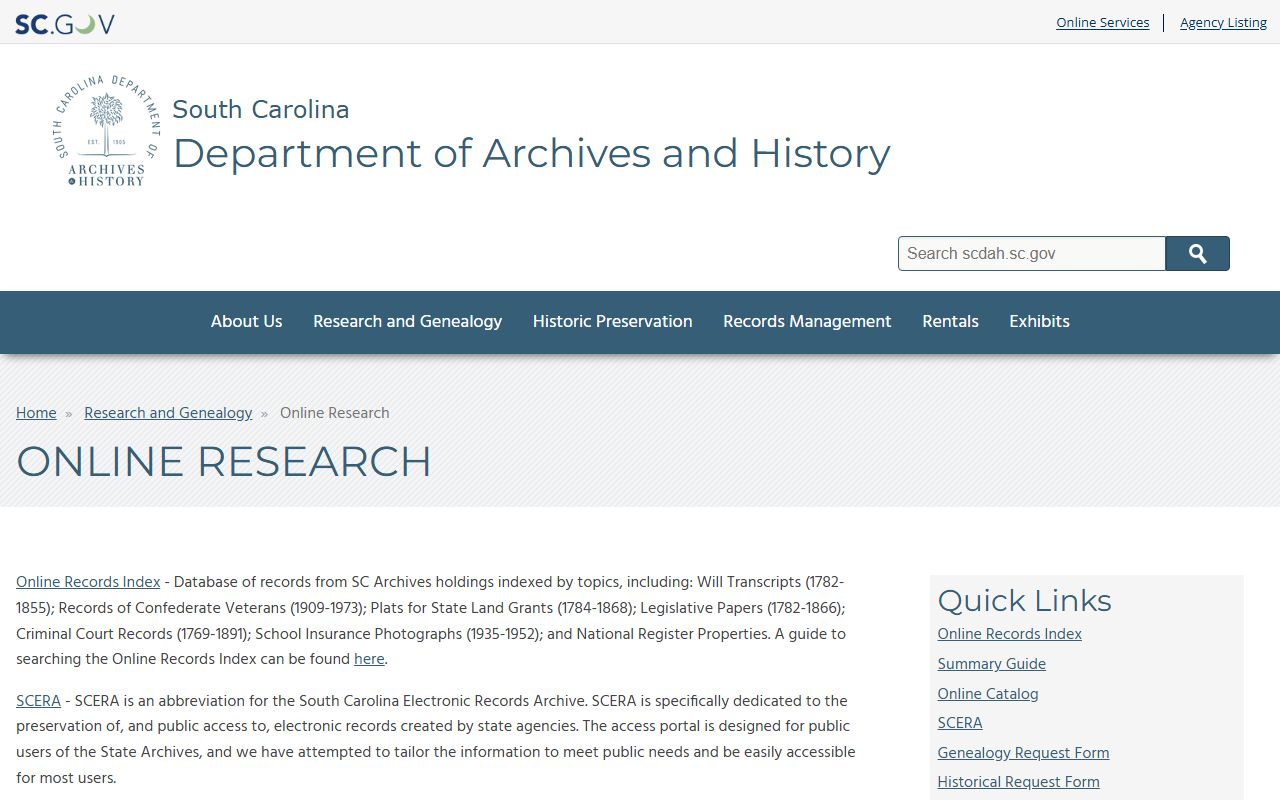
The Archives holds the most complete collection of pre-twentieth-century Edgefield County deed books and indexes, making it an essential stop for any serious historical research in the county.
Note: For records between 1786 and 1787, check both the Archives catalog and the county-level index books, as the earliest Edgefield records sometimes appear under slightly varying date ranges depending on the source.
Searching Edgefield County Deed Records Online
Several online tools give access to Edgefield County deed records. SC Property Checker Edgefield County provides deed record data and property ownership information in a searchable format.
SC Property Checker Edgefield County showing deed records and property data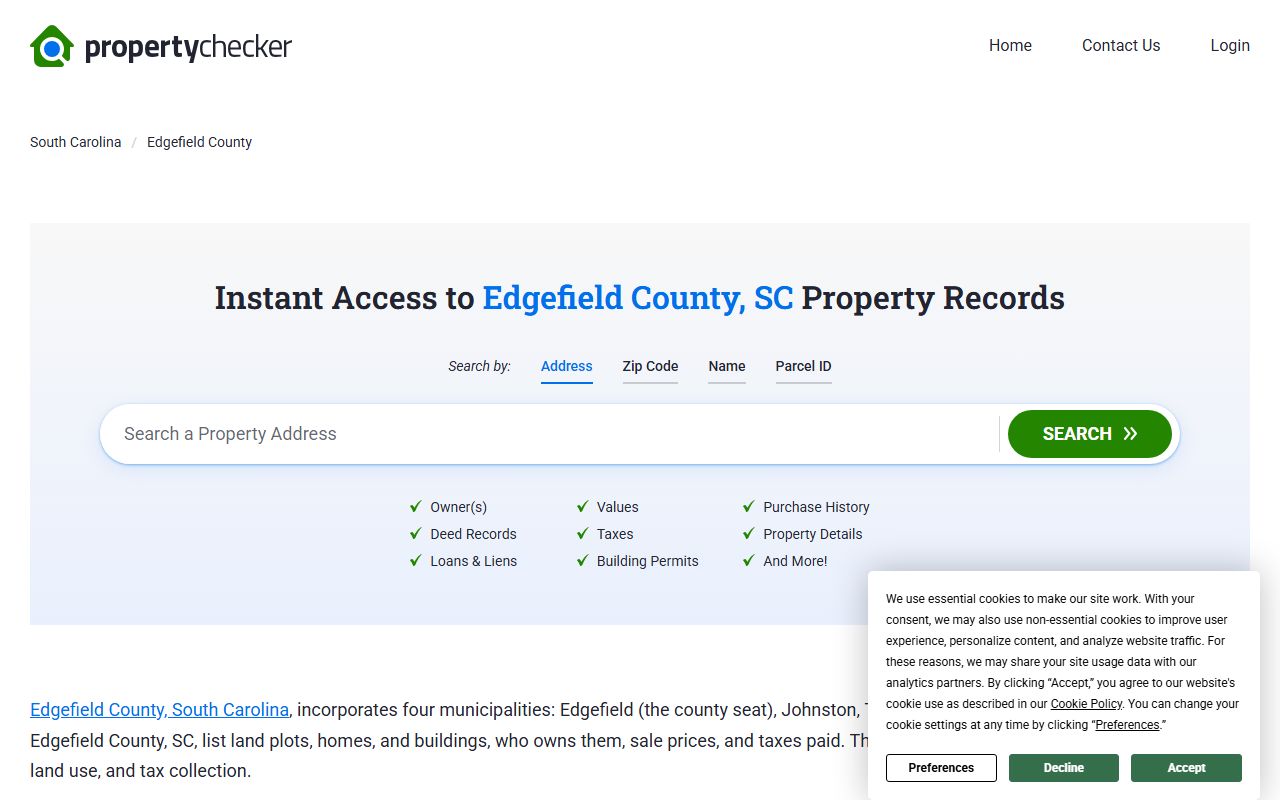
SC Property Checker lets you search by owner name or address to find recorded documents linked to specific parcels in Edgefield County.
The statewide SC Land Records portal also provides access to recorded instruments from Edgefield County alongside records from other South Carolina counties. The SCIWAY recording offices directory lists the Edgefield County Register of Deeds contact information and links to available county services.
For historical records, the OnGenealogy South Carolina land records directory catalogs which Edgefield County collections are available online versus on microfilm at the Archives.
What Edgefield County Deed Records Contain
A recorded deed in Edgefield County carries the grantor and grantee names and addresses, a legal description identifying the property, the consideration paid, the recording date, and the assigned instrument number. Under Section 30-5-35, deeds executed after July 1, 1976 must also include a derivation clause and the grantee's mailing address.
The legal description in an Edgefield County deed may reference a recorded plat, provide metes and bounds measurements, or describe the property by reference to a prior deed. Older deeds from the eighteenth and nineteenth centuries often use metes and bounds with references to natural features, neighboring landowners, and survey markers that no longer exist, making historical title research a specialized skill.
Beyond deeds, the Register of Deeds records mortgages showing liens on property, plat maps defining boundaries, mechanics liens filed by contractors, tax liens from federal and state authorities, and UCC filings. Each instrument type is indexed separately, and a complete title search in Edgefield County involves checking all relevant indexes to find every recorded instrument affecting a parcel.
Legal Requirements for Edgefield County Deed Recording
South Carolina law governs all recordings in Edgefield County. A deed must be in writing and signed by the grantor. The signature must be acknowledged before a notary or authorized officer under Section 30-5-30. This acknowledgment is not optional — the Register of Deeds will not record a deed without it.
Section 30-5-90 requires that documents lodged for recording be recorded within 30 days. In practice, most Edgefield County recordings occur the same business day. The date and time of recording determine priority between competing instruments. A deed recorded earlier wins over a later deed from the same grantor.
Under Section 30-7-70, recording gives constructive notice to all subsequent buyers and creditors. This means a buyer who fails to check deed records cannot later claim ignorance of a prior recorded deed. The public nature of the recording system protects everyone involved in Edgefield County property transactions.
Edgefield County Deed Records for Genealogy and Research
Few South Carolina counties offer the genealogical depth available in Edgefield County deed records. The county's early settlement history, combined with records dating to 1786 and 1787, makes it a rich source for researchers tracing Midlands families across multiple generations. Deed books from the pre-Civil War era often contain detailed descriptions of adjoining landowners, witness names, and family transactions that reveal kinship ties not apparent in other record types.
Post-Civil War records, including the Forfeited Land Records 1871–1878, document property changes that occurred during Reconstruction. These records show land that was forfeited for unpaid taxes and subsequently sold, often resulting in transfers that altered long-standing ownership patterns in the county.
Real estate mortgage books from 1872 to 1923 are particularly valuable for understanding economic history. They show which landowners borrowed against their property, who the lenders were, and how agricultural debt shaped land ownership in Edgefield County during the late nineteenth and early twentieth centuries.
Note: When researching Edgefield County families before 1785, check state-level land grant records at the SC Department of Archives and History, as county deed books had not yet been established.
Public Records Access in Edgefield County
Edgefield County deed records are open to the public under the South Carolina Freedom of Information Act, S.C. Code Section 30-4-10. Any person may review or request copies of recorded instruments. No reason is required to access public deed records.
Social Security numbers appearing in recorded documents available online may be redacted upon request. The physical record at the Register of Deeds is not changed, but the online image can be masked to prevent misuse. This protection is available to any person whose SSN appears in a Edgefield County recorded document.
Title companies, attorneys, lenders, real estate agents, and private researchers all use Edgefield County deed records regularly. A thorough title search in the county involves checking deed indexes, mortgage records, lien files, and plat books to build a complete picture of a property's ownership and encumbrance history.
Nearby Counties
Edgefield County borders Saluda, McCormick, Aiken, and Greenwood counties. Property records in these counties are maintained by their respective recording offices.