
Saluda County Deed Records and Property Record Access
Saluda County deed records are maintained by the Clerk of Court in Saluda, South Carolina. Unlike many counties with a separate Register of Deeds, Saluda County assigns all recording functions to the Clerk of Court, who handles land titles, mortgages, plats, liens, and other property instruments. Saluda County is located in the central South Carolina Piedmont and is one of the smaller counties in the state. Whether you are searching for a current deed, tracing ownership history, or locating a filed lien, the Clerk of Court is the official custodian of these records. All documents are open to the public under South Carolina law.
Saluda County Quick Facts
Where Saluda County Deed Records Are Kept
Saluda County deed records are maintained by the Clerk of Court in the county seat of Saluda. In a number of smaller South Carolina counties, the Clerk of Court serves the dual function of court administration and real property recording. Saluda County follows this model, meaning the same office that handles court filings also records deeds, mortgages, plats, and liens. All instruments submitted to the Clerk of Court for recording become part of the permanent public record.
The Saluda County Government website provides contact information for county offices, including the Clerk of Court. Saluda is a compact county seat community in the Piedmont region, and its courthouse serves as the central location for all property recording activities in the county. Researchers visiting in person will find deed index books, plat records, and related instruments maintained by the Clerk's office.
| Office | Saluda County Clerk of Court |
|---|---|
| County Seat | Saluda, SC |
| Recording Function | Clerk of Court handles all recording |
| Website | saludacounty.sc.gov |
| Public Records | Yes |
The SC Judicial Branch page on Register of Deeds information, shown below, provides statewide context for how deed recording functions operate across South Carolina, including in counties like Saluda where the Clerk of Court handles these duties.
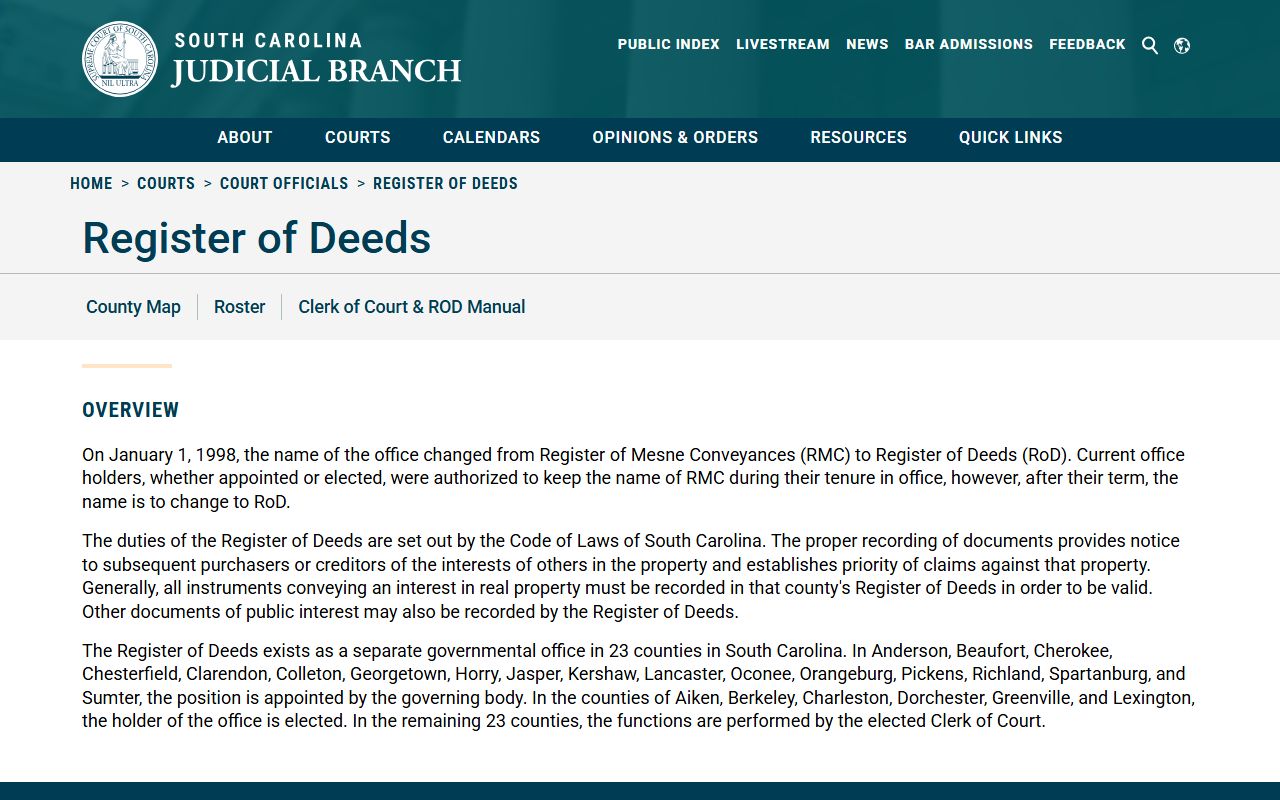
The SC Judicial Branch resource helps clarify which office in each county is responsible for recording real property instruments, which is particularly useful for counties like Saluda where the Clerk of Court performs these functions.
Note: Saluda County does not have a separate elected Register of Deeds. All deed recording functions are performed by the Clerk of Court.How to Search Saluda County Deed Records Online
Online access to Saluda County deed records is available through state-level tools. The SC Land Records portal provides free public access to recorded instruments from participating South Carolina counties. Users can search by grantor or grantee name, instrument type, or book and page reference. Coverage for Saluda County may be partial for older records, so some historical instruments may require an in-person visit to the Clerk of Court in Saluda.
The SC Property Checker for Saluda County provides aggregated property and deed data in a searchable format. This tool can be useful for identifying current property owners, reviewing recent deed transfers, and examining parcel details. The SCIWAY directory at sciway.net lists the contact information for the Saluda County recording office alongside all other South Carolina counties.
Shown below is the SC Property Checker view for Saluda County, which organizes deed record data from the Clerk of Court into a searchable database for public use.
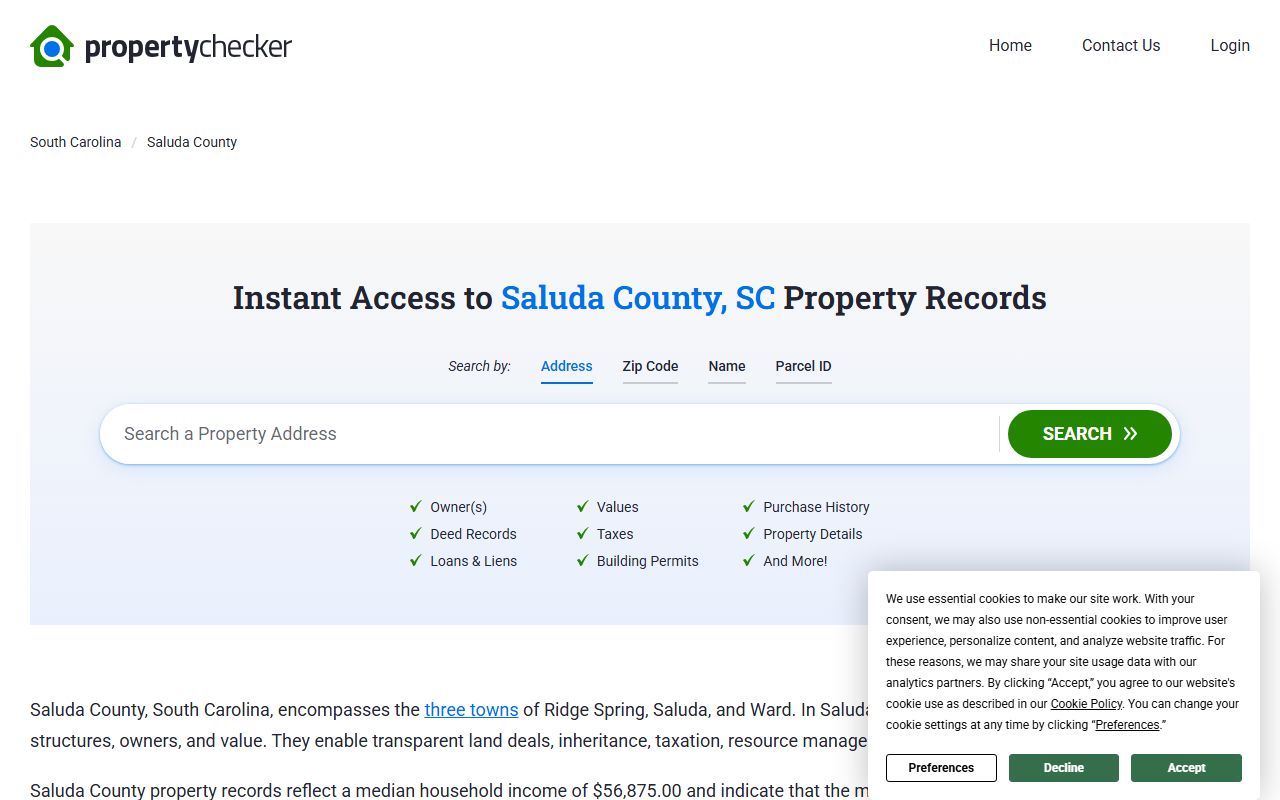
Using online tools before visiting the courthouse can identify the specific instrument book and page you need, making an in-person visit more efficient.
What Saluda County Deed Records Contain
Deed records in Saluda County contain the standard elements required by South Carolina law. The grantor and grantee are identified by name and address. A legal description of the property is required, either in metes and bounds or by reference to a recorded plat. The consideration, representing the value exchanged, is stated on most deeds. Upon filing, the instrument receives a book and page reference and an instrument number that serve as the permanent locator in the Clerk of Court's deed index.
Section 30-5-35 of the South Carolina Code requires that deeds executed after July 1, 1976, include a derivation clause. This clause names the source from which the grantor received title, maintaining continuity in the chain of ownership. The grantee's mailing address is also required. These two requirements are standard elements in any properly prepared deed filed with the Saluda County Clerk of Court.
Additional content that may appear on a Saluda County deed includes easements, agricultural use restrictions, road access rights, and deed covenants. Tax map numbers and plat cross-references are commonly included, particularly for rural parcels. Saluda County has a largely agricultural character, and deed language for farm tracts often includes references to drainage, access roads, and prior recorded easements that affect the use and boundaries of the property.
Note: Some Saluda County deed records for older rural properties may use informal boundary descriptions that require professional survey work to interpret accurately.Documents Recorded in Saluda County
The Saluda County Clerk of Court records a range of real property instruments. The office handles warranty deeds, quitclaim deeds, deeds of gift, mortgages, deeds of trust, plats, and various types of liens. Powers of attorney affecting real property are also filed here. Each instrument type serves a distinct purpose in the legal framework of property ownership and encumbrance. The Clerk of Court maintains a comprehensive index of all recorded instruments that can be searched by party name, recording date, or instrument type.
Saluda County's rural and agricultural character means the office also records instruments related to farmland, timber rights, and long-standing family land transfers. Many parcels in the county have been held within the same family for generations, and deed records from the Clerk of Court document these multi-generational ownership chains in detail.
- Warranty deeds and quitclaim deeds
- Mortgages and deeds of trust
- Plats and boundary surveys
- Mechanics liens and tax liens
- Powers of attorney
- Deeds of gift and family conveyances
Saluda County Deed Recording Requirements Under State Law
Recording requirements for Saluda County deed records follow Title 30, Chapter 5 of the South Carolina Code. Section 30-5-30 requires that every deed be acknowledged before a notary public or other authorized officer before it can be accepted for recording by the Clerk of Court. The acknowledgment verifies that the grantor signed the document voluntarily and that the execution was genuine. Instruments not properly acknowledged will be rejected at submission.
The state deed stamp tax under Section 12-24-10 is $1.85 per $500 of the stated consideration. This fee is typically the responsibility of the grantor. Per-page recording fees are also collected by the Clerk of Court at the time of submission. Under Section 30-5-90, all submitted documents must be recorded within 30 days. Timely recording protects the grantee's title against any subsequent purchaser who lacks notice of the earlier transfer.
Property liens in Saluda County are subject to the priority and filing rules established by Section 30-7-70. Recording a lien with the Clerk of Court provides constructive notice to all future parties searching the title. The recording date and time determine the lien's priority relative to other recorded claims on the same parcel.
Historical Saluda County Deed Records
Saluda County was formed in 1895 from Edgefield County and has a recording history that extends back to its formation. Before 1895, property records for the area now comprising Saluda County were maintained under Edgefield County. Title researchers working on older parcels in Saluda County may need to trace records through Edgefield County's deed books to complete a full chain of title for pre-1895 transactions.
The South Carolina Department of Archives and History maintains historical land grant records and early plats for the broader Edgefield and Saluda region. These records are valuable for genealogical research and for title work on older rural parcels where the pre-county formation history is relevant. The SCDAH's online tools provide indexed access to many of these instruments, making remote research possible before a courthouse visit.
Many Saluda County properties have remained in the same family for multiple generations, which can create complex title histories involving estate transfers, family deeds, and informal conveyances. The Clerk of Court's deed index is the primary tool for tracing these ownership chains within the county's 1895-to-present record range. For family transfers recorded through probate proceedings, the probate court records held separately by the county are also relevant to title research.
Note: For Saluda County property records before 1895, researchers must search Edgefield County deed records, as Saluda was part of Edgefield prior to its formation.Certified Copies and Fees in Saluda County
Certified copies of Saluda County deed records can be obtained from the Clerk of Court in person or by mail. Certified copies carry the official seal and are accepted in legal proceedings. Standard uncertified photocopies are available at a lower per-page fee. Contact the Clerk of Court before visiting or submitting a mail request to confirm the current fee schedule and accepted payment methods, as fees are subject to change by county ordinance.
To request a specific document, provide the grantor and grantee names, the recording date or approximate time period, and the instrument book and page number if available. For older records without full index information, a property description or reference to a known plat may help staff locate the correct instrument. Mail requests should include a return envelope and payment in the accepted form.
Public Access to Saluda County Property Records
Deed records in Saluda County are public records. The South Carolina Freedom of Information Act at S.C. Code Section 30-4-10 gives any person the right to inspect or receive copies of public documents held by the Clerk of Court. No reason is required to make a records request. This open-access framework applies equally to all filed instruments, including older records that predate the current electronic index system.
South Carolina law also protects individuals whose Social Security numbers appear on recorded documents. Any person whose Social Security number is visible on a publicly available online copy of a recorded instrument may request that the Clerk of Court redact the number from the digital version. The physical record remains unchanged, but the online display will be updated to remove the sensitive information. This protection is available to any recording party in Saluda County.
Nearby Counties
Saluda County borders Lexington, Newberry, Edgefield, Aiken, and Greenwood counties in the central South Carolina Piedmont region.