
Anderson County Deed Records and Property Search
Anderson County maintains a dedicated Register of Deeds office that serves as the official keeper of all real property instruments in the county. The office is appointed and provides a Public Access System that allows searches by TMS number, owner name, and street name. Anderson County has one of the longest deed record histories in the Upstate region, with conveyance books dating back to 1789. Records from the predecessor Pendleton County, which existed from 1790 to 1816, add even more depth to the historical record available here.
Anderson County Quick Facts
Anderson County Register of Deeds Office
The Anderson County Register of Deeds is the appointed recording office for all real property instruments in the county. The office accepts, indexes, and stores deeds, plats, mortgages, liens, and other real property documents. It also provides copies of recorded instruments for a fee. The Register's office sits in the Anderson County Courthouse and serves title companies, attorneys, lenders, and members of the public on a daily basis.
The county's official recording page at andersoncountysc.org/register-of-deeds outlines available services and provides access to the Public Access System. This online tool lets users search by tax map number, owner name, or street address. Copies of plats and deeds are available upon request. The County Office page for Anderson County also lists service details and location information.
| Office | Anderson County Register of Deeds |
|---|---|
| Address | 100 South Main Street, Anderson, SC 29624 |
| Phone | (864) 260-4053 |
| Hours | Monday - Friday, 8:30 AM - 5:00 PM |
| Website | andersoncountysc.org |
The image below shows the County Office directory page for Anderson County Register of Deeds, which provides location and service details for the recording office.
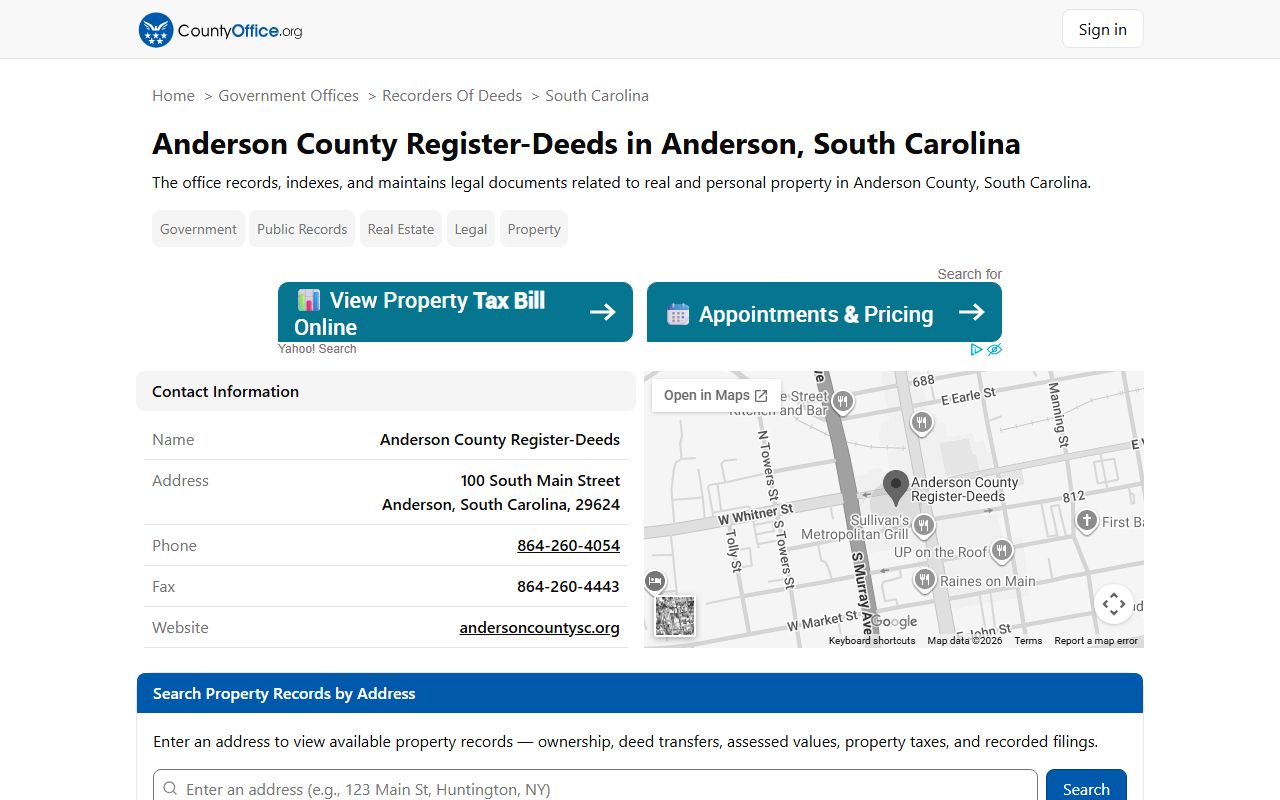
The directory listing provides quick reference for office hours, contact details, and available recording services.
Searching Anderson County Deed Records
Anderson County offers several ways to search deed records. The Public Access System on the county website allows searches by TMS number, owner name, and street name. This is one of the more flexible search tools available in the Upstate region. The statewide SC Land Records portal is also available and provides free access to deed documents for participating counties. For Anderson County, the portal may cover a range of more recently recorded instruments.
The SC Property Checker for Anderson County aggregates deed and parcel data and allows name-based and address-based searches. It is a helpful tool for quick ownership lookups and deed history reviews. For genealogical research, the FamilySearch wiki for Anderson County lists available records and points to digitized deed books covering years from the late 1700s onward.
Below is a view of the SC Property Checker tool for Anderson County, which provides access to deed records and parcel ownership information throughout the county.
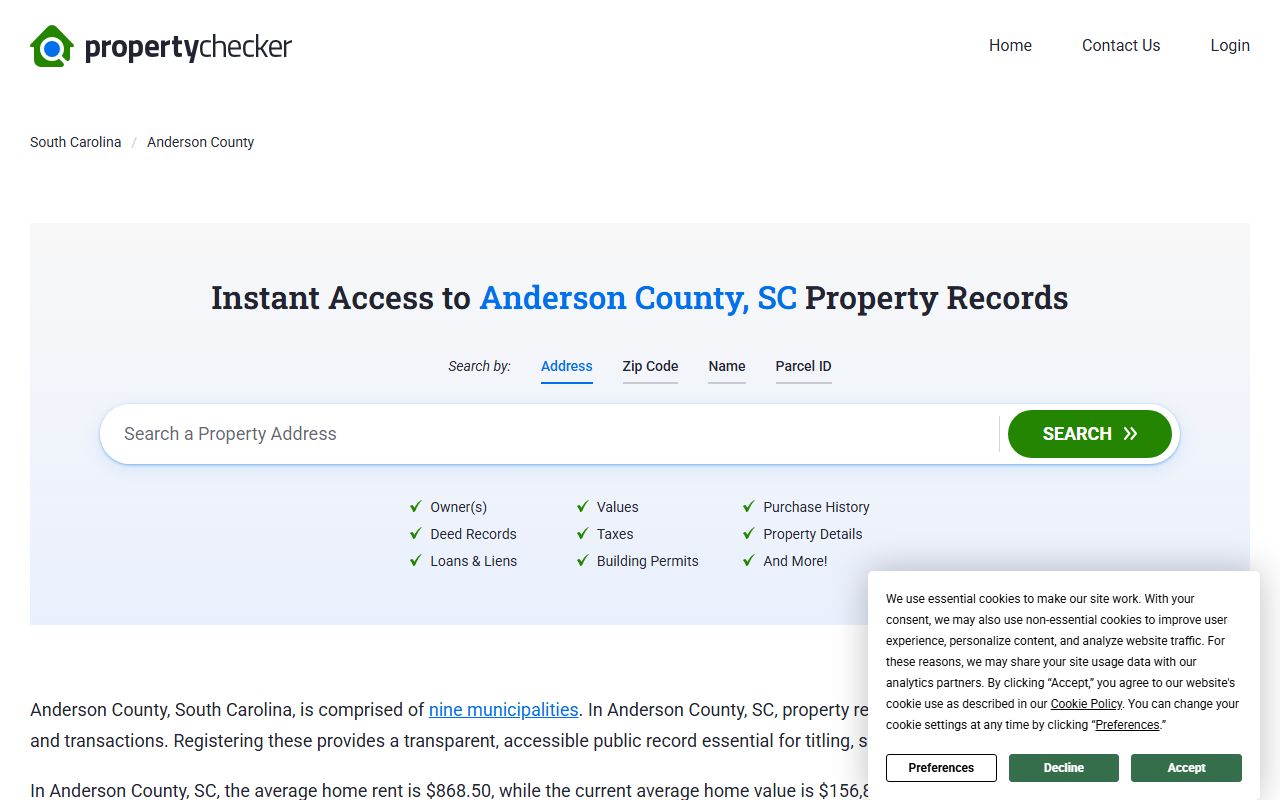
Combining the county's Public Access System with statewide tools gives researchers the broadest coverage across different time periods.
Note: Anderson County deed records from before 1789 may be found under Pendleton County, which was the predecessor to both Anderson and Pickens counties.What Anderson County Deed Records Contain
Every deed recorded in Anderson County includes the grantor and grantee names with their addresses. The legal description of the property is a core element, defining the exact boundaries of the land being transferred. This description may use metes and bounds language based on old survey monuments, or it may reference a recorded plat by book and page number. The consideration, or value stated for the transfer, also appears on the document.
Deeds executed after July 1, 1976 must carry a derivation clause under Section 30-5-35, which identifies the prior instrument through which the grantor received title. The grantee's mailing address is required on those same documents. Recording date and instrument number are assigned at the time of filing and become part of the permanent index.
Easements, deed restrictions, and homeowners association covenants may also be referenced or recited in the deed body. For plats, the document shows boundary lines, dimensions, setbacks, and any reservations or dedication of roads. All of these elements are public information once the document is recorded.
Historical Deed Records in Anderson County
Few counties in South Carolina can match Anderson County's depth of historical land records. Conveyance books from 1789 to 1901 cover more than a century of property transfers. Index volumes to conveyances run from 1790 to 1948. Plat books from 1803 to 1864, and additional volumes from 1866 and 1871, preserve the early surveying and subdivision history of the county. Real estate mortgage books from 1872 to 1907 add to the financial history of land ownership.
Records from Pendleton County, which served as the parent jurisdiction from 1790 to 1816, are also part of the Anderson County historical record collection. When Anderson and Pickens counties were formed from Pendleton in 1826, the older records were preserved. Original deed books at the courthouse have been microfilmed and cover years from 1786 to 1865. The South Carolina Department of Archives and History has additional historical materials accessible online.
For researchers using genealogical platforms, FamilySearch has digitized several series of Anderson County land records. The OnGenealogy SC land records directory identifies which years and record types are available digitally, making it easier to plan a research trip or remote search.
Documents Recorded by the Anderson County Register of Deeds
The Register of Deeds in Anderson County handles the full range of real property instruments recognized under South Carolina law. Warranty deeds are the most frequently filed deed type, providing the grantor's guarantee that the title is free and clear of undisclosed encumbrances. Quitclaim deeds transfer whatever interest the grantor holds, making no guarantee about the quality of title. Deeds of gift move ownership without a cash sale and are common in family transfers.
Mortgages and deeds of trust are filed by lenders when real property secures a loan. Plats are recorded when a new subdivision is created or a parcel is formally surveyed. Mechanics liens, tax liens, and UCC financing statements establish creditors' interests in real or personal property. Powers of attorney relating to real estate transactions are also recorded so that third parties can confirm the authority of the acting party.
- Warranty deeds, quitclaim deeds, and deeds of gift
- Mortgages and deeds of trust
- Plats and subdivision plats
- Mechanics liens and tax liens
- UCC financing statements
- Powers of attorney
Recording Requirements and Fees in Anderson County
Recording a deed in Anderson County requires compliance with Title 30, Chapter 5 of the South Carolina Code. Section 30-5-30 requires that each deed be acknowledged by the grantor before a notary public or proved by a witness. Without this acknowledgment, the Register of Deeds will not accept the document for recording. South Carolina does not allow deeds to be recorded without this verification step.
The deed transfer fee under Section 12-24-10 is $1.85 for every $500 of stated value. This is the grantor's responsibility. The base recording fee varies by county but generally runs $10 to $15 for the first page and $5 for each additional page. Documents must be recorded within 30 days of being lodged with the office per Section 30-5-90. Late filing can affect lien priority and constructive notice to subsequent purchasers.
Lien recording rules under Section 30-7-70 set out how creditors must file their claims and how priority among competing interests is determined. Following these rules closely is important for anyone recording an encumbrance against Anderson County real property.
Public Access and Copies of Anderson County Deed Records
All deed records filed in Anderson County are public records under S.C. Code Section 30-4-10, the South Carolina Freedom of Information Act. Any member of the public may inspect or request copies without explaining why they want the information. This applies to all filed instruments, including deeds, mortgages, plats, and liens. The Register of Deeds office is required to make these records available during normal business hours.
Certified copies are available for a fee and carry the Register's official seal. Standard uncertified copies cost less and are sufficient for most research purposes. Copies of plats are also available upon request. Contact the office directly to confirm current fee schedules before submitting a request by mail. If a Social Security number appears on any filed document, the person identified may ask the Register to redact it from the online version of the record.
Related Property Resources in Anderson County
Deed records in Anderson County work alongside assessor data, GIS maps, and probate records to give a full picture of property ownership. The Anderson County Assessor maintains tax values and parcel descriptions for every property in the county. GIS tools allow users to view parcel maps and identify surrounding parcels. Together these resources support due diligence for buyers, attorneys, and lenders.
The SCIWAY county recording directory at sciway.net lists Anderson County among its statewide directory of recording offices. This can be a helpful reference for anyone who needs quick contact details or wants to compare how different counties handle recording services across South Carolina.
Nearby Counties
Anderson County is located in the northwestern corner of South Carolina and shares borders with several Upstate counties, each with their own deed recording systems.